
Barrows: All right, but you stay right there. Don’t peek.
McCoy: My dear girl, I am a doctor. When I peek, it’s in the line of duty.
Star Trek – Season 1: Episode 17 – “Shore Leave”

Barrows: All right, but you stay right there. Don’t peek.
McCoy: My dear girl, I am a doctor. When I peek, it’s in the line of duty.
Star Trek – Season 1: Episode 17 – “Shore Leave”
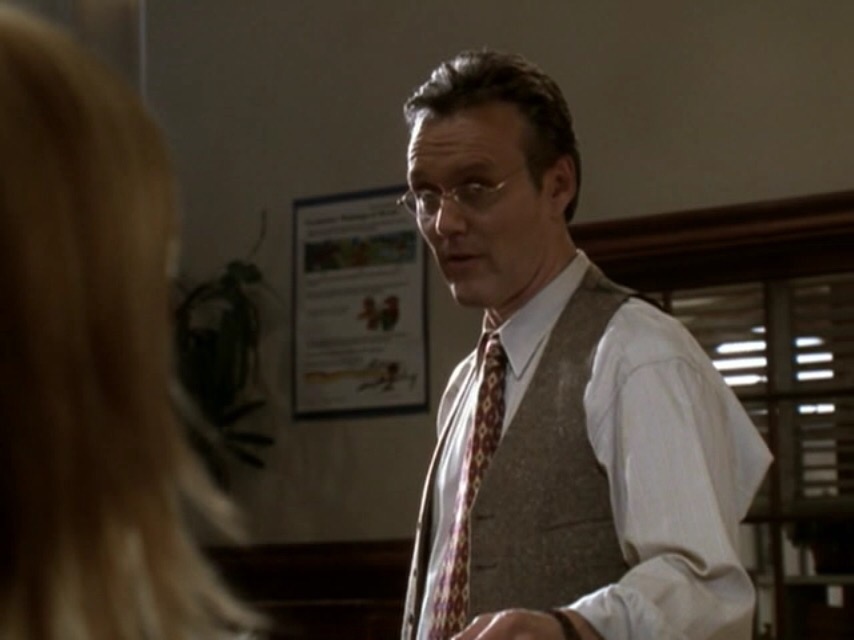
Giles: Here. I suspect your mother will want to, uh, put it on the refrigerator.
Buffy: Yeah. She saw these scores, and her head spun around and exploded.
Giles: I-I’ve been on the Hellmouth too long. That was metaphorical, yes?
Buffy: Yes. She was happy.
Buffy the Vampire Slayer — Season 3: Episode 8 — “Lovers Walk”
‘Yes, I thank you. They are used to my ways here. Perfect, if only the woman of the house did not take it upon herself to play the physician, merely because I keep my bed some hours every day. “No, ma’am,” I say to her, “I will not drink Godfrey’s Cordial, nor try Ward’s drop. I do not tell you how to dress this salmagundi, for you are a cook; pray do not tell me how to order my regimen, for as you know, I am a medical man.” “No sir,” says she, “but our Sarah, which she was in just the same case as you, having been overset at the bear-baiting when six months gone, took great adwantage from Godfrey; so pray, sir, do try this spoonful.” Jack Aubrey was just the same. “I do not pretend to teach you to sail your sloop or poop or whatever you call the damn machine; do not therefore pretend –” But it is all one. Nostrums from the fairground quack, old wives’ remedies – bah! If rage could reunite my sinews, I should be as compact as a lithosperm.’
Sir Joseph had intended to suggest the waters of Bath, but now he said, ‘I hope your friend is well?’
HMS Surprise – Patrick O’Brian


Book: A duel?
Wash: With swords?
Simon: Captain’s a good fighter, he must know how to handle a sword.
Zoe: I think he knows which end to hold.
Firefly – Episode 4 – “Shindig”

This post is part of the Movie Scientist Blogathon, hosted by Christina Wehnerand Silver Screenings. Day 1 is all about good scientists, day 2 is for mad scientists, and day 3 covers lonely scientists.
Scientists are often lonely creatures. Between the time they spend in labs, doing research, sorting through endless data, and working on equipment, it’s easy to see why. But while scientists in the real world often work in teams with others, movie scientists typically don’t have that luxury, making movie scientists some of the loneliest characters onscreen. In the movies, scientists are often at odds with society or those in power, often serving as the lone voice of reason in a chaotic story. Frequently they have to pursue their studies alone, whether by choice or because they’ve been ostracized from everyone else, and sometimes their passions and beliefs make it hard for them to connect to others when the opportunity arises. No matter if the movie scientist is a good one, a mad one, or even an evil one, loneliness seems like it’s typically part of the journey for these characters. And in my mind there’s no lonelier scientist on film than Ellie Arroway from Contact.


Spock: I picked this up from Doctor McCoy’s log. We have a crew member aboard who’s showing signs of stress and fatigue. Reaction time down nine to twelve percent, associational reading norm minus three.
Kirk: That’s much too low a rating.
Spock: He’s becoming irritable and quarrelsome, yet he refuses to take rest and rehabilitation. Now, He has that right, but we’ve found
Kirk: A crewman’s right ends where the safety of the ship begins. That man will go a shore on my orders. What’s his name?
Spock: James Kirk. Enjoy yourself, Captain.
Star Trek – Season 1: Episode 17 – “Shore Leave”

This post is part of the Movie Scientist Blogathon, hosted by Christina Wehner and Silver Screenings. Day 1 is all about good scientists, day 2 is for mad scientists, and day 3 covers lonely scientists.
The idea of “mad scientists” is probably as old as science, and it’s certainly been around since the beginning of cinema. There are countless iterations, from Victor Frankenstein to Dr. Jekyll, and it’s easy to see why the concept makes for such compelling storytelling. They’re often tragic heroes in the classic sense, full of noble intentions but undone by their own ambition or shortsightedness. The mad scientist is of course distinct from the “evil genius”. Where an evil genius is typically the villain of a story, using their knowledge and ability for nefarious purposes, the mad scientist is typically a character with noble intentions who is subject to the tragic flaw of being unable to see the consequences of their actions until they’re too late. (Then there are good scientists who are just kind of crazy or reclusive, whom I wouldn’t typically classify as “mad.) To me, there’s no better use of the mad scientist trope than in last year’s Avengers: Age of Ultron.
 The Love Pirate