Bluey’s “The Sign” – The greatest episode of television, one year later

In recent years I’ve gone into New Year’s Eve with a specific plan on what I wanted to watch to ring in the New Year. Taking inspiration from those viral posts that say things like “If you start Star Wars at such-and-such a time, then the Death Star will explode at midnight,” I frequently try to time my viewing in a similar way. Last year it was the musical episode of Star Trek: Strange New Worlds, “Subspace Rhapsody,” and its climactic destruction of the rift at episode’s end. Before that it was the explosion of The Monitor in Tomorrowland, and prior to that it was the line “My turn,” in Serenity. Last year I went in a different direction, opting for a marathon of the insanely popular children’s show Bluey to bring my 2024 to a close.

That may seem like a strange choice for a 40 year old adult to watch by himself while waiting for midnight, especially when you consider that we have a 6 year old in our house and Bluey is on pretty much constantly anyway. But after one of the hardest and most exhausting years, the kindness and goodness of Bluey is like a balm to my weary soul. There’s a reason it’s beloved by parents and kids alike, but also a comfort show to people of all ages whether they have children or not. Its 8 minute episodes are heart-warming, hilarious, adorable, and touching, and you can watch 32 of them in an evening with no problem. But beyond all of that is the episode “The Sign,” the climax of my marathon that I timed for midnight. It’s a special, 28 minute masterpiece episode, the penultimate one of the latest third season of the show, and quite possibly one of the greatest works of animation, television, and visual storytelling ever crafted.

They say the sign of a good work of art is when it sticks with you long after you’ve seen it. “The Sign” is that for me. I haven’t been able to get it out of my head since it debuted in April of 2024. I’ve watched those 28 minutes dozens and dozens of times, many times with my son at his request, but frequently early in the morning before work or late at night before bed. It’s become a palate cleanser after a hard day, or it helps me on mornings I need some extra strength to get through the day, or even just when I need a way to refocus. “The Sign” works on on so many levels. It’s perfect on its own, hitting the themes of the story it’s telling, but it also works as the culmination of the 150 or so episodes that came before. It’s filled with cameos, appearances, and references from throughout the series and it brings together and ties up multiple storylines that have carried through the seasons. But also, like the series as a whole, it has profound things to say about childhood, parenthood, and family, and it does it without ever needing to spell out its specific messages. Instead, it lets its meaning sink in over time, as it is watched over and over, and thoughts and feelings are digested and reexamined to grow deeper and more meaningful.

It’s easy to imagine that “The Sign” was conceived as a series finale (minus the epilogue episode, “Surprise”), as it is replete with talk of endings. The Heelers’ life as they know it is ending in favor of a new and “better” one. But it’s not just their lives that are ending, with Frisky and Rad potentially moving as well, but the lives of all the others who are intertwined with this family. Friends, neighbors, classmates, cousins, grandparents, and more will be affected by this end. The fear, anger, and sadness over this ending sets the emotional groundwork, drives the story, and amplifies the themes of “The Sign.”

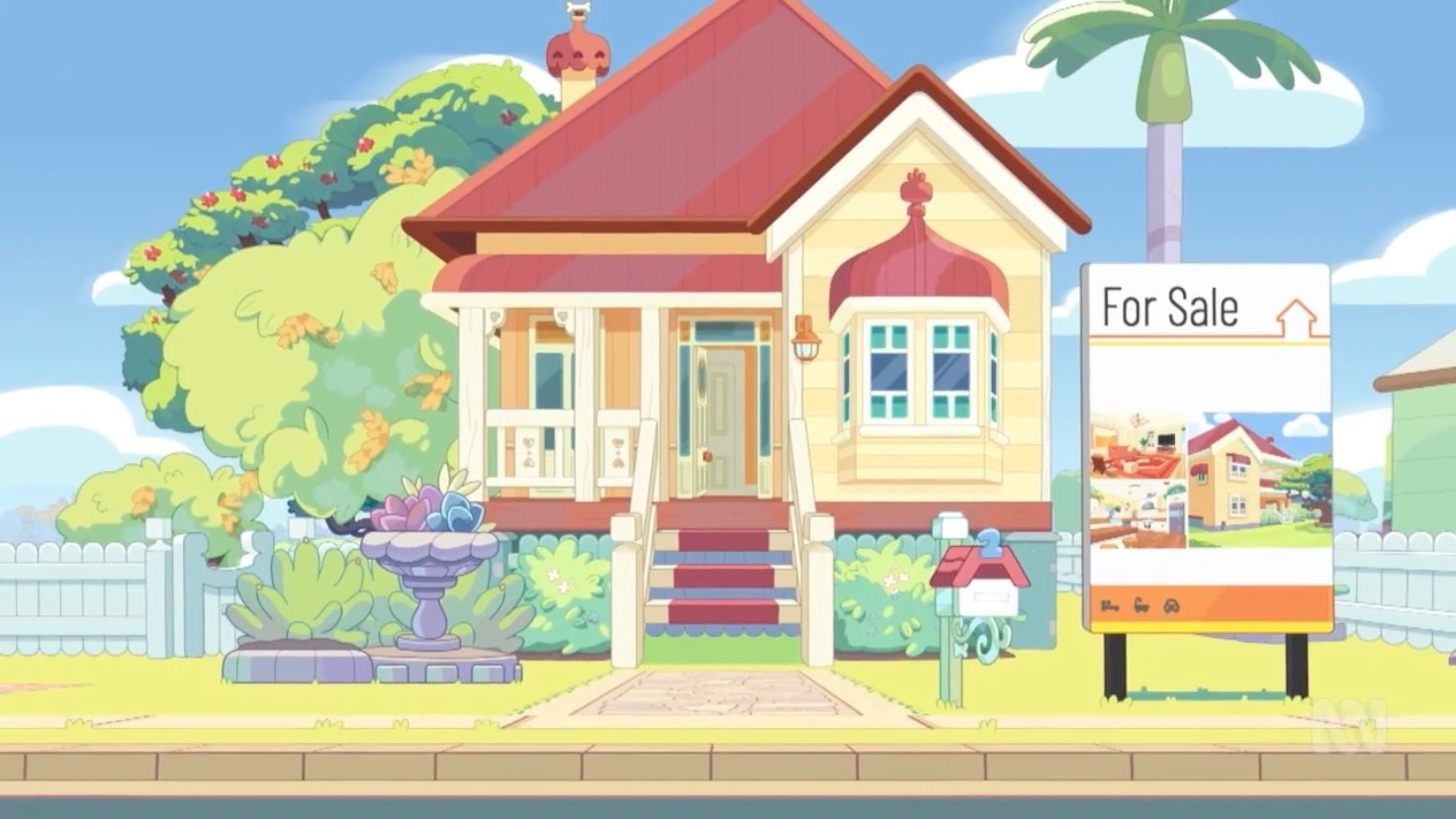
“The Sign” picks up right where the previous episode, “Ghost basket,” left us, with its surprising cliffhanger reveal that a game of realtor turned out to be a way for the Heelers to process the very real “For Sale” sign in front of their home. Bluey isn’t known for cliffhangers, or even connected episodes, even while it will occasionally call back to earlier events. Characters come and go, and there is a sense of the passage of time, but you couldn’t genuinely say that Bluey has story arcs. Needless to say, the revelation that the Heelers are selling their home and will be moving was as much of a shock to audiences as it probably was to Bluey and Bingo.

At the start of “The Sign” we see how this upcoming change has impacted the Heeler family, not only disrupting their playtime and routines but dominating their thoughts and conversations. The younger Bingo seems blissfully ok with everything, not minding whatever happens, but the elder Blue can’t seem to stop either worrying about what lies ahead or lamenting what she imagines will be lost. Meanwhile, parents Bandit and Chilli try to reassure Bluey while struggling with their own mixed feelings on the decision they have made in the open of creating a better life for their girls.

At school Bluey’s teacher, the ever-wise Calypso, responds to the class’s despair over losing Bluey by telling the story of The Farmer. With its repeated refrain of “We’ll see,” it offers a lesson in the dangers of assuming the best or the worst outcome of any event, big or small. It illustrates for the children that the future can’t be guessed and that current events aren’t a guarantee of what will come. It shows how small events can have large consequences, for good or bad, and that the complex causality of the world requires an understanding that to find peace requires a willingness to accept whatever future is to come.

Here is where the brilliance of “The Sign” starts to shine, from the very start of this quadruple-sized episode, but to start to understand why you need to understand the show as a whole. The secret success of Bluey is that it’s the direct opposite of other shows for children, even and especially those that are loved by both parents and kids in the same way Bluey is. The most overall successful shows for young children are those that are made for kids but which provide enough humor, references, or entertainment aimed at parents to keep parents engaged and amused while they still craft their stories around the children. I think what makes Bluey stand out is that it’s actually made for parents with its messages, morals, and storylines, while aiming to keep children entertained.

One of the most common praises of Bluey is that it’s about the power of play, particularly imaginative play, for children. This is not a lesson kids need to learn, because they already innately know it. Bluey‘s mission is to teach parents this lesson, to show them how to play with their children, to show them why that play is important and how it can teach children the lessons parents seem so eager to squeeze into children’s brains. In the vast majority of the episodes it’s Bandit and Chilli who learn a lesson in how to relate to their kids, even and especially when the kids also learn a lesson. The lessons of Bluey for parents are the importance of setting aside adult cares and concerns and connecting with kids on their level, the need to join in with kids in whatever it is they want to do, how it feels to be a kid and experience things through the lens of play and how that can help a parent to connect to a kid. Bluey does everything differently than other kids shows, because it aims itself squarely at the parents watching alongside, knowing that parents need these examples spelled out for them while kids will learn things naturally through play, connection, and experience the way all kids do.

So while Calypso’s lesson to Bluey feels like it’s the main arc of the story, as Bluey learns to let go of worrying and embrace the random but interconnected nature of the universe in order to find peace in an uncertain future, it’s actually Chilli who really needs to learn that lesson, and she in fact learns it from Bluey. As she and the four cousins chase down Aunt Frisky, we see what seems like a series of unconnected events that culminates in tracking her down at the lookout. For every development that gets them closer to Frisky another obstacle pops up in their path, and it feels like a real life lesson out of The Farmer for Bluey’s benefit. Here’s the list of what they encounter on their hunt for Frisky:

  • There aren’t enough seats in the back of Bobo for Bluey so she has to sit in the front seat.
  • Bluey sitting in the front seat leads to being pulled over by the police. But the police officer saw Frisky by the juice shop.
  • A car blocks their view of Frisky’s car in the parking lot of the juice store. A coin on the floor of the shop distracts them from seeing Frisky leave. Chilli gets juice for the girls.
  • Muffin spills her juice in the car, forcing them to pull over so Chilli can clean. While stopped, they’re in a perfect spot for Socks to see Frisky’s blue car pass by.
  • They’re hot on Frisky’s trail when Socks needs to pee and they have to stop. While stopped, a butterfly flaps into the car with them.
  • The butterfly makes its appearance and Chilli pulls over to let it out. She happens to pull over right in front of a sign for the lookout, leading them to Frisky.

On the face of it, this feels straight out of The Farmer and it, along with a heart-to-heart with Chilli, Frisky, and Bluey, leads the trio to embrace the idea of “We’ll see.” Chilli learns the importance of being honest with Bluey about her feelings, about the fear and sadness she feels, and that connection helps them both grow to a position to support each other through this upcoming change. As with all things Bluey, it’s the parents that need to be explicitly taught the lesson that the kids will come to grips with more naturally through their experiences. Cue the wedding, the party, and all the joy of this last celebration at the Heeler house.
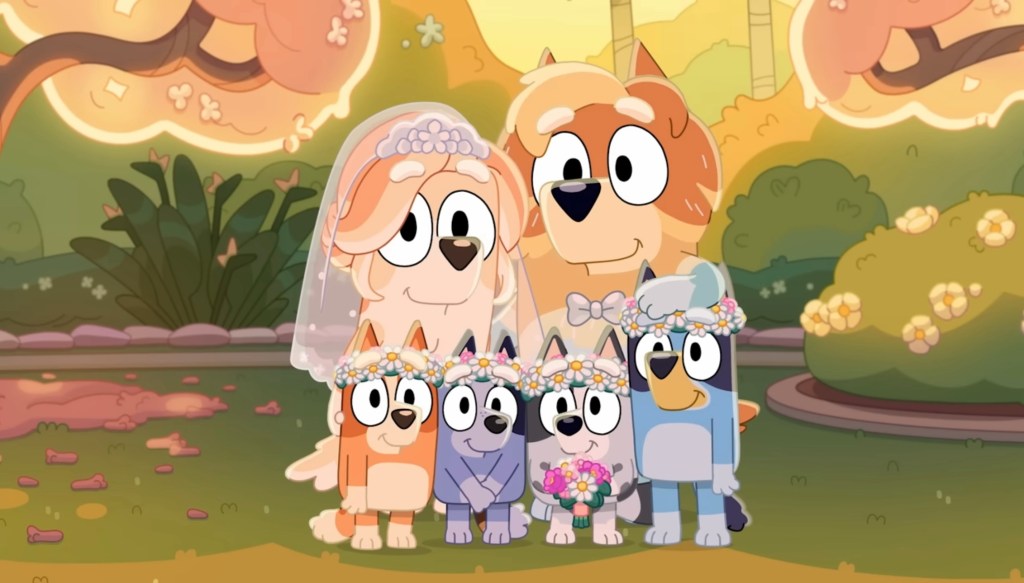
On any other show, that would be the end of it. This series finale-esque episode would end with the family ready to accept a new, uncertain future, and they would move to a new city ready to start a new adventure together. After all, that’s the lesson Calypso was trying to teach Bluey, right? But “The Sign” is not a normal episode of TV, and Bluey is not any other show. Because the lessons for the Bandit and Chilli are not over yet, and the list of events above were not what they appeared.

Before I go on, I have to go back. The episode of Bluey that first cemented its enduring importance to me was “Dance Mode,” an early episode of season 2. We didn’t start watching Bluey when it first became available in the US, but hopped on the bandwagon once season 2 was at least partially out. I enjoyed the first season and revealed in its humor and its heart, but it didn’t imprint on me fully until “Dance Mode.” That classic episode has the family learning that they’re all pushing Bingo to suppress what she wants in order to get what they want, and that Bandit and Chilli are just as guilty of this as elder sister Bluey. So in the end, to make it up to Bingo, they all agree to go into Dance Mode in front of a big crowd watching a street musician. And before they go wild in only the way the Heelers can, Bandit makes the announcement, “Ladies and gentlemen, I’m doing this for my kid!”

That, to me, is what Bluey is all about: what we do for our kids. Sometimes episodes are just an example of what parenthood is like, with its frustrations, delays, messes, distractions, and needs. It’s that constant feeling that all we do all day is do things for our kids. But other episodes are examples of what we can do for our kids, the experiences, support, and encouragement we can give them, the example we can provide, the understanding and connection we can foster. As parents, we don’t just do things for our kids in the sense that they have demands we’re meeting, but we do things for our kids because it brings us and them joy, because we love them, and because it gives meaning to all of our lives. That’s what Bluey is.

So to really get to the heart of “The Sign” we have to go to Bandit, who is largely absent from the plot of the episode. He is left behind on the chase after Frisky, and he’s not a part of the “We’ll see” lesson learned by the girls. But if the moral of the show as whole is “I’m doing this for my kid,” then for “The Sign” it has to come back to Bandit. It’s Bandit who articulates the pressure of providing Bluey and Bingo with a better life, even as he and Chilli clearly made the decision to move together. His refrain in the face of Chilli and Bluey’s despair is that it’s a movie that will make things better, even if it means giving up what they have. “I’m doing this for my kid,” are the words you can imagine him saying in his head over and over. So much so that you can go back to the episode “Stickbird” and watch Bandit’s struggle with something weighing him down and make the connection that he might have gotten the job offer before their beach trip and was trying to figure out what he was willing to do for his kids.

So with Bandit’s turmoil in mind, let’s look back at that list of events that seemed to alternately bring them closer to Frisky and farther from Frisky with each turn. Knowing the momentous ending of “The Sign,” we can view those events in a different light. Because while they seem like random obstacles and coincidences on the path to Frisky, they’re actually something more. Because the ultimate consequence of those events, that even Bluey will probably never know, is not to end of up at Frisky but instead to get a coin stuck in the slot of that particular pair of binoculars at that particular moment, so that a pair of dogs with no eyes can use it to spot another house for sale.

When viewed in that light, the list of events contains no obstacles at all, but is instead the universe (and writer Joe Brumm) making all of the precise moves required to get that coin to that slot. If they had caught Frisky any sooner or if they had lost her completely they never would have made it to the lookout. Things happened the only way they could have to get the coin into that slot. And then when you think about that, you have to think about what else had to happen to reach that outcome, including the chaos that is Muffin. Someone had to drop a coin in that exact spot for Bluey to find. Rad had to tell Stripe his plans for Frisky to move and Stripe had to blurt it out to Frisky and cause her to run away. Frisky had to get a speeding ticket in order for Chilli to track her to the juice shop so Bluey could find the coin.

But there’s more, and here’s where the “The Sign” grows to encompass 150 episodes of this series. If Rad and Frisky had not accidentally been double booked as babysitters, no coin in the slot. If Bingo and Lila hadn’t saved the caterpillar that became Flappy the butterfly that caused Chilli to pull over at that exact spot by the Lookout sign, no coin in the slot. But take another step further back and it’s not even about the coin in the slot, as that’s only one half of the picture. What do the dogs with no eyes look at through the binoculars with Bluey’s coin? They spot a house for sale with a pool. Whose house? Winton and his dad. Why are they moving? Because Winton’s dad is moving in with the Terrier’s mom. How did they get together? Because the kids were running around and dancing together in the “TV Shop” looking for Coco at the pharmacy, where she has bum worms. There’s a line that has stuck with me for decades from the book The Alchemist by Paulo Coelho. “When you want something, all the universe conspires in helping you to achieve it.” The Bluey universe conspires, even beyond the Heeler family, all to lead to one fateful phone call.

So here we are at the finale, the real lesson of “The Sign,” and what ties the entire series together. We know what happens. The Heelers are moving out, ready to pull away from the house they love into an uncertain future, when that phone rings one last time. No words are exchanged, there’s no dialogue, nothing has to be spelled out. Meg Washington’s gorgeous “Lazarus Drug” plays as Bandit takes the call, hears the news from Bucky the realtor, and makes a choice. That’s the lesson of “The Sign,” and it’s one that complements and almost contradicts “We’ll see.” If the center of the episode is about the importance of finding peace with whatever the future offers, the final moments are about the power of choice. And in true Bluey style, it’s a lesson for the parents.

The universe has conspired to put the family in that one particular moment. Having faced the future, as ready as they can be to embark on a new adventure together, the universe presents them with a moment of choice. And with a year now since the episode first aired to reflect on the weight of that choice, there are so many questions we can ask about the factors weighing in Bandit’s mind. On the one hand there’s a job with more money to provide the traditional “better life” he seeks for the kids. Chilli is on board, they’ve made plans together, and this is the path they’re on, but you can feel in the air and in the music that it’s not the future they want, it’s the one they think they’re supposed to have. So the universe gives them, gives Bandit, one final moment to make a choice.
While it seems obvious that he would choose the happiness of their home over more money, what don’t we see that he might also be giving up? Does he give up the career path he wants? Is he having to return to a job he doesn’t like? We know it’s one that has sent him away for weeks at a time, that has him having to work from home at times instead of play with the kids, and that forces him to leave when the kids want him to stay. Maybe the new job would have better hours, less travel, or provide more family time. Maybe he won’t be able to return to his old job at all, and will have to find a new one. Maybe the new job would have allowed Chilli to not have to work her airport security job, allowing her more time with Bluey and Bingo, or more time for her own pursuits, letting her play hockey or travel or do the other things she wants to do with her life. Maybe Bandit and Chilli would have been happier in the new city in spite of what they gave up in their own life, even if it meant forcing the kids to rebuild their lives as well.

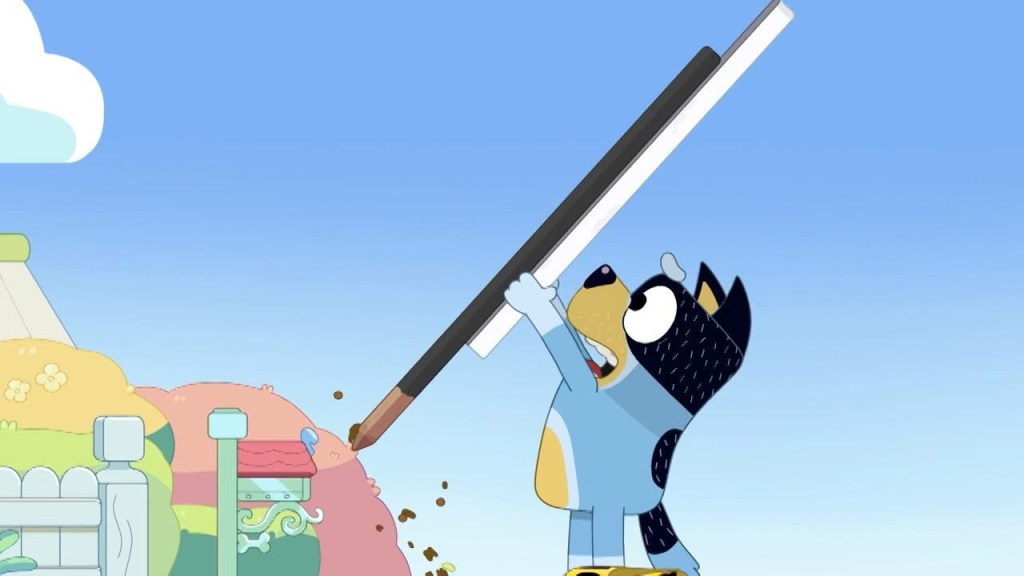
With all of that potential running through his mind, and with the universe providing the opportunity, Bandit makes a choice. It’s ultimately the choice they all wanted, but we can feel how hard that choice is in the strength it takes to pull that sign out of the ground and toss it into the street. We’ll never know what the Heelers gave up in order to stay at home, what Bandit and Chilli are giving up, but we know through the very power of that moment that the consequences are as heavy as that sign. “Ladies and gentlemen, I’m doing this for my kid.”

It’s no coincidence that at the wedding the same music from “Dance Mode” played. That theme of sacrifice, of work, of burden that comes with being a parent is ever present in Bluey, alongside the joy that those things bring from connecting with your kids. Because no matter how hard it was for Bandit to pull out that sign, no matter what he sacrificed to keep the life the family knows and loves, the joy that immediately comes over everyone makes it worth it. The tackle of Chilli, the rush of Bluey and Bingo to join the hug, the way the music swells with ecstasy as Bluey and Bingo rush through their new home, filled with a new appreciation of what they have and understanding that there’s a cost to keep it even if they don’t fully know that cost. It’s what makes it all worth it. (Also, seriously, how good is the arrangement of “Lazarus Drug” the music team and Joff Bush have concocted? Meg Washington’s song is amazing, but the orchestration of this version and the way it amplifies the emotion is absolute perfection.) “I’m doing this for my kid.” So much weight, pain, struggle, joy, and love in that phrase, and in this show.

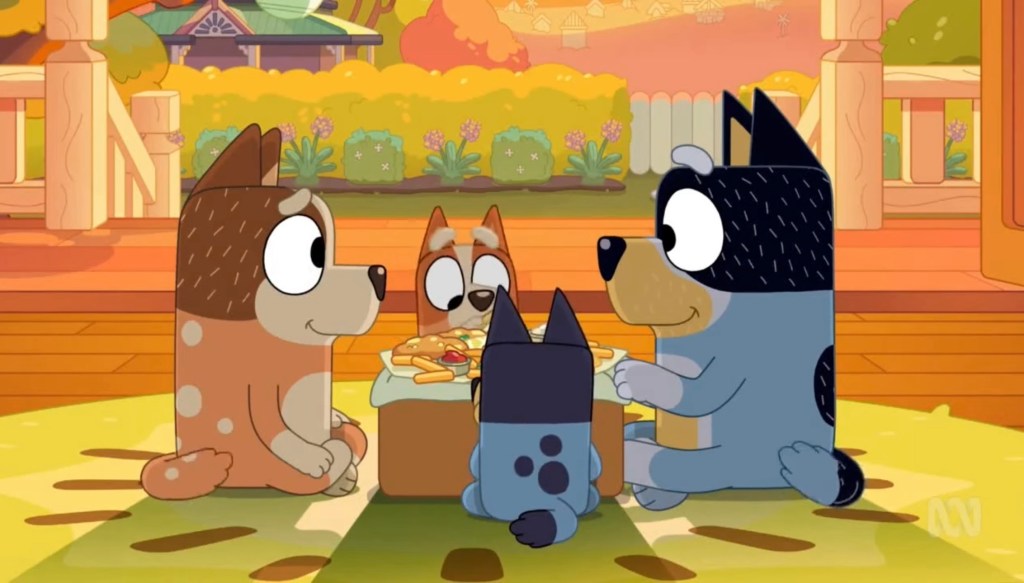
I saw a comment from someone when the episode came out that said that the meal the Heelers share in the final moments of the episode is probably the greatest meal of their entire lives, and that thought hasn’t left me since I read it. You can imagine the feeling of that meal, with the family free to play and imagine again with the fear and uncertainty gone, gathered around a cardboard box table on the famous kiwi rug. Those fries, which make great mustaches, probably tasted perfect, as the sun sets and the tails start to wag. While Bluey and Bingo are already back to normal, as kids bounce back so quickly, you can feel the tension ease in Bandit and Chilli as tails start to wag and you know the family will be alright.
Just to hammer the point home, “The Sign” is not the final episode of the season (or series, as it is yet to be seen if the show will return, although we know a movie has been announced). There’s one more “Surprise” still to come, whose message is almost literally “I’m doing this for my kid.” This is one where Bluey does learn a lesson, having asked what it’s like being a parent and seeing firsthand through play what Bandit is willing to do for Bingo’s (or Otarya’s) pretend children. But Bandit and we adults in the audience learn a lesson as well, that our kids do see and understand what we do for them, the sacrifices we make, the burdens we carry, and the help we provide. And when we let them see that, they’ll be prepared for the journey of parenthood one day themselves as well.

When I say that “The Sign” is not only my favorite episode of Bluey, my favorite episode of television, but also perhaps my favorite work of narrative fiction of all time, I hope this gives you an idea of why. It is a masterpiece of course, but it’s so thematically resonant, not only for parents but especially if you happen to be a parent. It encapsulates the heart of the show, “I’m doing this for my kid,” but also hammers home the power of choice in that statement. When you become a parent, every choice you make, consciously or unconsciously, is about what you’re doing for your kid. Some choices are easy. We choose to feed our kid and provide them a bed and take them to school. Some choices are hard. What school we send them to, what activities we sign them up for, what values we teach them and what kind of environment we provide for them. Some are big, one time choices we make that affect the course of their lives. Some choices are small ones we make every day, but those can often be the hardest. We choose to get up and go to work every day to support them. We choose to set aside our anger or frustration or exhaustion or sadness to play with them, to encourage them, to support them, to give them attention. They may not understand the weight behind those choices, or how hard they can be, but they know we’re making them and they see them every day, and that’s how they learn to make their own choices. Bluey teaches parents that, among many other things. And hey, the kids enjoy it too.

How to pick a movie

For my 40th birthday last month, my wife gifted me a movie obligation. She booked a movie theater and invited our friends to a private showing of a movie of my choice. I have no doubt she had the best of intentions with this kind and thoughtful gift. But now I have the burden of choosing a movie to watch, not just by myself or with the two of us at home, but on the big screen with a group of our friends. And my mom. And maybe our son. It’s a big decision.

Those who know me well know that it’s probably going to be that movie. You know the one. That one that’s been my favorite for decades, that I haven’t gotten to see on the big screen in over 30 years. One that had a very particular connection between my dad and I. The one that helped cement my love of cinema, that has my favorite moment in my favorite scene of all time. Directed by my favorite director and scored by my favorite composer. That one.

Or, it could be that other one. Everyone who knows me knows that other one. That one that’s almost 10 years old now, that felt made just for me, that spoke to the very soul of who I am, who I want to be, and how I define myself. You know the one. That one that underperformed at the box office and quietly disappeared, which I may never get the chance to see on the big screen again. The one I carry a piece of around with me at all times. How could I say no to that one?

There are some rules, of course, both written and unwritten. The theater is booked for 2.5 hours, so no Lord of the Rings marathons. It has to be either something currently showing or something I own on DVD. But beyond that, I have the opinions of a dozen or so other people to consider.

Do I pick a crowd-pleaser? Something I know everyone will like? It’s mostly a group of Millennials and GenX, so there are some obvious ones in there. I could do Back to the Future or The Princess Bride or Jurassic Park, something everyone has seen a million times and knows all the dialogue to. But my mom will also be there, and I should modulate my pick to align with her sensibilities (keep the sex and nudity to a minimum). And what about our 6-year-old son? He’s not specifically invited, and we’ve got a babysitter available, but I’d hate to leave him out. There are a million movies that could work for my friends, my mom, and our son, but they’re all things that most people will probably have watched a million times. And while I could watch The Little Mermaid any day of the week, that doesn’t feel special enough for the event.

Or I could say the hell with everybody else and just pick something for me. I could even broaden some horizons in the process. Why not Apocalypse Now: Redux? Other than the nudity and the running length, I mean. Schindler’s List? It’s the greatest film ever made, but boy would that be a terrible thing to subject your friends to. Ok, how about My Dinner with Andre? Nothing like inviting your friends to watch a movie that put you to sleep the first time you saw it. I adore A Prairie Home Companion, and that would be something different for sure. I know one person who would love to see Geostorm on the big screen again, but it’s not fair to pick a movie just for the two of us. Something weird with subtitles? Brotherhood of the Wolf. The Philosophers would be a fantastic pick, but I don’t know that anyone would appreciate it as much as I would. And there aren’t many feelings worse than showing something you love to people you care about and not getting the reaction you hoped for.

I could do something I love to watch and have seen a million times without getting tired of it. I could do Twister. I love Twister so much. Or Independence Day. How about The Muppet Christmas Carol? Who cares if it’s August? Pirates of the Caribbean? I’d really rather watch At World’s End, but that’s over the running time. Maybe Master and Commander: The Far Side of the World, one of my dad’s favorites. Or Serenity? I’ve managed to see that a bunch of times on the big screen, though. If we’re aiming for things the kiddo can watch, I couldn’t go wrong with WALL-E or Ratatouille. Then again, seeing Speed Racer on the big screen again would be a trip.

Then there’s always Star Wars. But which one? Return of the Jedi is my favorite, but A New Hope is the one people would expect. Rogue One would be a great standalone choice. Or, since it’s for my 40th birthday, I could go with Indiana Jones and the Temple of Doom. It is, after all, the movie that made my mom go into labor with me. Or I could go with a classic that I love, something like High Noon, or Duck Soup, or City Lights. I could go musical. Something more modern like Moulin Rouge or an older favorite like Singin’ in the Rain.

Maybe what I really want is to watch the Bluey episode “The Sign” four times in a row…

You see my dilemma? I’ve got a big decision to make, and one that’ll affect several hours of my friends’ lives. It’s my birthday party, and I really can pick whatever I want, but I can’t just think of myself. And there are just so many choices. But we all know it’ll be that one. You know the one. Who am I trying to kid? It was always going to be that one.

Unless, of course, it’s that other one…

Matilda, Annie, and the Generation Gap

“When I’m stuck with a day
That’s gray, and lonely
I just stick out my chin
And grin, and say, oh
The sun’ll come out tomorrow
So ya gotta hang on ’till tomorrow
Come what may”

-Annie

“Just because you find that life’s not fair, it
Doesn’t mean that you just have to grin and bear it
If you always take it on the chin and wear it
Nothing will change
Just because I find myself in this story
It doesn’t mean that everything is written for me
If I think the ending is fixed already
I might as well be saying I think that it’s OK
And that’s not right”

-Matilda

I never had much of a relationship with any version of Matilda before the recently released film Matilda the Musical now on Netflix. Despite being a Roald Dahl fan as a kid in the 80’s/90’s, I somehow never read the original story. As a result, I didn’t make an effort to see the 1996 film, which I might have felt a little too old for at the time. The 2011 stage musical, which the new film adapts for the screen, never made it to my home of Tucson on its national tour. So despite a passing familiarity with the story and plenty of opportunities to connect with the material through my 38 years, I went into this new version of Matilda the Musical as a mostly blank slate, with my 4.5-year-old son beside me.

It instantly became our new household obsession. We’ve watched it four times in the last nine days, our son demands the soundtrack to be played at every opportunity, and he requests that I sing its climactic number, “Revolting Children,” for his bedtime song every night. It has spectacularly catchy and clever music, kinetic and exciting choreography, gorgeous production design, excellent performances from both the kids and adults in the cast, and a story that speaks to universal values of justice and equality.

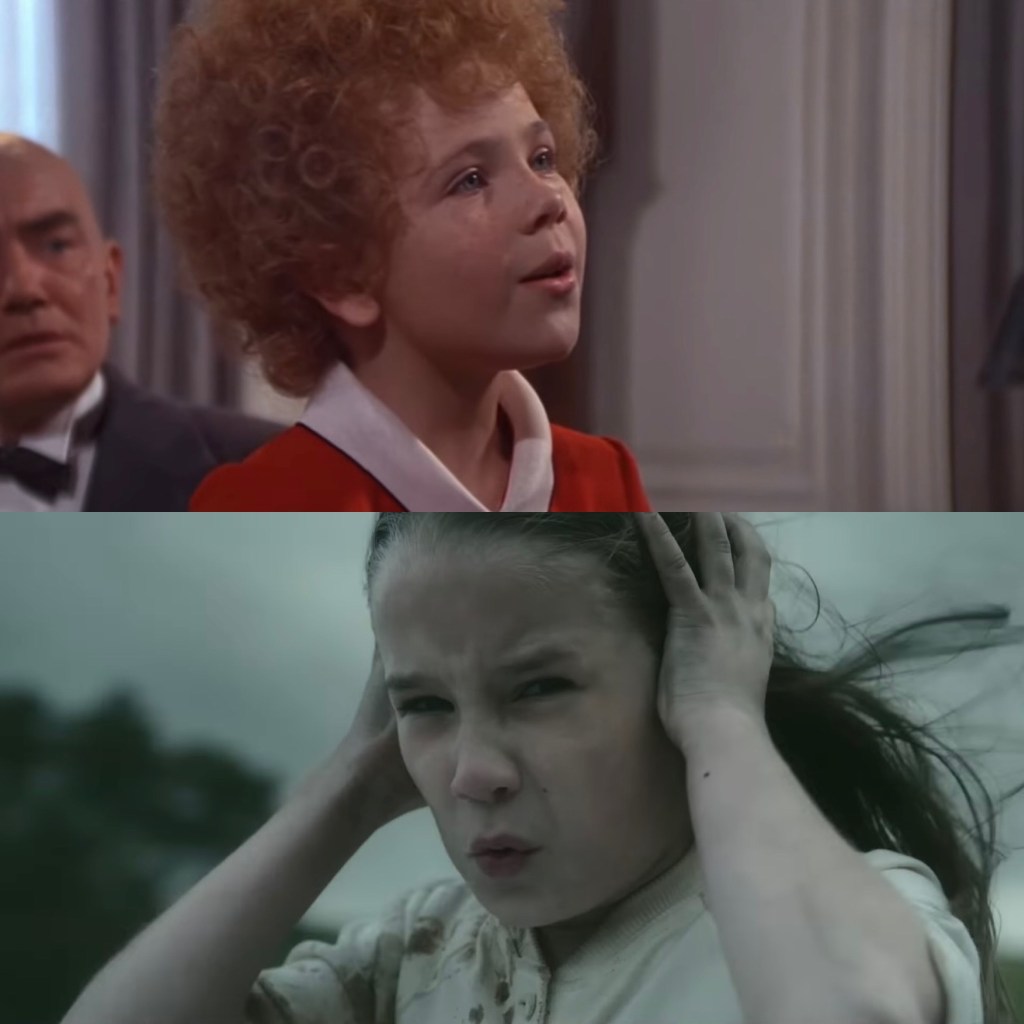
It also has a lot of parallels to the iconic musical Annie, which were brought to the forefront of my mind yesterday when by coincidence my wife and I had tickets to see the current national tour. Our son asked to watch Matilda the Musical yesterday morning and our tickets for Annie were in the afternoon, and the juxtaposition of the two similar musicals in the same day had my mind reeling. Unlike Matilda, I have a long relationship with Annie, which was the first musical I ever saw on stage. My mother and grandmother took me to a performance as a young child, and it ignited my love of musical theater. Those first three dynamite songs (“Maybe,” “Hard Knock Life,” and “Tomorrow”) combined with the strong pull on the heartstrings that comes from Annie calling Sandy and having him come to her captured my imagination. We would have taken our son to Annie yesterday, because he would have loved it, but when the tickets were purchased almost a year ago we didn’t know whether he’d be old enough. (As it is, his first musical theater experience was The Lion King, which isn’t a bad way to go either.)

I love Annie. Its songs are almost all iconic for a reason, even as I notice things now as an adult that I didn’t notice as a kid. For instance, Annie opens with its three best songs in the first 20 minutes, and is forced to reprise them throughout while the remainder of the still-great songs fade in comparison. Still, I sang “Tomorrow” to my son when he was an infant, and I look forward to introducing him to Annie the next time it comes through town. But after watching it and Matilda back to back yesterday, I’m much happier to have my son singing along to Matilda (as he currently is while sitting next to me as I type and we watch it again) than to Annie, despite my love for both.

The Annie vs Matilda dynamic seems to perfectly speak to the generation gaps in today’s society, particularly between Boomers and Millennials. The two musicals, so superficially similar with their plucky young female protagonists, were written for very different audiences in very different times and have very different things to say about children, their places in society, and how they should act. Annie and Matilda, the characters, both start in awful circumstances with evil, neglectful, abusive guardians, come face to face with injustice and inequality, and end their stories in the care of loving, supportive parent figures. Their stories, however, couldn’t be more different, and those differences can tell us a lot about the disconnects between Boomers and Millennials.

Annie first debuted onstage in 1977, with music by Charles Strause, lyrics by Martin Charnin, and a book by Thomas Meehan. It’s based on the “Little Orphan Annie” comic strip which began in 1924 and which spawned film adaptations and a radio show before it made its way to the stage. Its high point of popularity was during the Great Depression and before World War II. As such it wasn’t the childhood staple of Boomers as much as it would have been for their parents, though it would have been regularly published in newspapers during Boomers’ youth. 

By the time of the Annie musical, Boomers would have been in their mid 30s, many with Gen-X children of their own to watch it with. The 1930’s setting of the musical, with its hardships of the Depression and the looming prospect of war, was intended to resonate with adult audiences who had lived through their own hardships of the Nixon era and the horrors of the Vietnam War. Its message of optimism and unity in that older era spoke to the need for optimism to try to lift the national mood in the 70’s. I can imagine that message speaking to parents of children who hoped their kids would grow up in a more positive situation.

Matilda, the novel, was published in 1988 and many Millenials doubtlessly grew up with either the book or the popular 1996 Mara Wilson film. By the time the musical debuted in 2011, with music and lyrics by Tim Minchin and a book by Dennis Kelly, those Millennials had grown into young adults of the sort likely to go see a stage version of a story they loved as kids. And now with the movie another decade later, many of us now have children of our own to introduce to the story. But what speaks to us is very different from what spoke to parents of young kids in the 1970’s.

What is Annie’s defining characteristic? What motivates her? How does she follow that motivation and where does it lead her? Annie is primarily defined by her goodness and her sunny optimism. She looks after the other kids in Miss Hannigan’s orphanage, helping them when they wake up crying in the night. She dreams of finding her parents, who left her a note and a locket, and she runs away determined to do so. She has an irrepressibly positive attitude, as we hear in her signature song, and every move she makes is rooted in that attitude.

Matilda’s defining characteristics, on the other hand, are her genius brain and her sense of justice. Her motivations are to learn and to fight for fairness. These lead her to be a troublemaker, to challenge authority, and to ask questions of those in charge. Both girls try to protect their friends and those who are oppressed or down on their luck, but they do it in completely different ways. 

Annie shines her positive light to inspire the grownups to be more like her, good and kind. She brings together Republican billionaire Oliver Warbucks and Democrat president Roosevelt (who was hated by “Little Orphan Annie” creator Harold Gray) to catch the bad guys, create the New Deal, and eliminate the Hoovervilles like the one she passes through early in the play. Unity, honesty, and benevolence save the day in Annie’s world.

Matilda inspires those around her as well, but she doesn’t waste her time trying to appeal to the better nature of those in authority. Instead she uses her powers to destroy the tool of Miss Trunchbull’s oppression (the nightmarish “Chokey” dungeon), lends her bravery to her peers so that they stand on their desks in open rebellion against their headmistress, and frightens and then flings her bodily (at least in the new film) from her seat of power. Her righteous anger about the state of things makes her fight back in a way that’s completely foreign to the world of Annie.

The musical Annie treats its children like plot devices. Sure, Annie is a great character, with pluck and wit and charm, with great songs to sing. She sees the good in the world and helps things to turn out better in the end. But other than running away at the beginning she doesn’t actually do much other than be a positive presence. She melts Daddy Warbucks’ heart and inspires Roosevelt and his Cabinet, but she doesn’t drive the plot once Warbucks takes her in. Miss Hannigan’s and Rooster’s plot comes and goes without any particular input from her. Warbucks’ assistant, Grace, first notices the scam and it’s foiled due to Warbucks and his government connections to Roosevelt and the FBI. A wealthy benefactor having his attitude changed just by Annie’s mere presence is all it takes to save the day.

Matilda treats its children like humans, with agency, skills, and power. Matilda, the character, drives the plot. She’s thrown from one awful situation in her home into another awful situation at Trunchbull’s school. She bonds with her schoolmates and helps to protect them when they’re in danger. She uses her cleverness to foil Trunchbull’s plans, and when injustice happens she dares to shout, “No!” in the face of those in charge, inspiring everyone around her. As her power grows and Trunchbull’s rage to match it, she uncovers the headmistress’s evil past, tears down the Chokey, exposes Trunchbull’s crimes, and eventually drives her away for good. All of the positive change happens because of the children, and not Matilda alone. She doesn’t lead the final revolt, though her stands earlier in the film helped inspire the bravery of the others.

Annie and Matilda treat the systems we have to deal with completely differently. Annie sees its conflicts resolved by working within the system to find compromises between those with power to craft a New Deal. The massive amount of unhoused people are helped by being given jobs that will ultimately make one of the richest men on Earth even richer. The rising tide will theoretically lift all boats, and they’ll be well prepared to fight the enemy looming on the horizon, while the rich who never had to suffer any of the hardships of the common folk will continue to thrive. Matilda resolves its larger conflicts by ultimately tearing down the system, removing the unjust from power, and building something completely new. The evil headmistress is banished, the oppressive school is rebuilt into something completely different, and the neglectful parents are sent away. Matilda argues that sometimes there is no common ground, that those in charge who made things the way they are should be removed from power, and that the systems that enable abuses should be dismantled.

Even the good adults of these stories speak to very different values. Daddy Warbucks is one of the richest men in the world, a billionaire among millionaires, who isn’t in any way required to be kind or generous, but ultimately decides to be thanks to the goodness of his adopted daughter. His staff are all kind, good people, but they’re also presumably well paid with a generally benevolent boss in a time when those living in the Hoovervilles would probably do anything for their jobs. Can you imagine a popular musical today where the hero is a billionaire industrialist whose powerful connections help save the day?

Matilda‘s heroic adults are her teacher, Miss Honey, and the operator of the mobile library, Mrs. Phelps (not coincidentally, two women of color). Having a teacher and a librarian as the only two good adults in the story was a move that has only gotten stronger in the decade since the musical debuted, given how threatened our schools and educators, libraries and librarians are these days. Mrs. Phelps offers Matilda a refuge (though she does not know from what), an outlet for her stories and imagination, and an endless supply of knowledge through her books. Miss Honey is just as bullied by Miss Trunchbull as the students, as much of a victim of both the woman in charge and the system as a whole. Miss Honey admits after a question by Matilda that teachers are very poorly paid, and she is paid less than most. She lives in a rundown shack but has come to accept that, “it isn’t much but it is enough for me.”

In the opening number of act two (at least how the story is split on stage), “When I Grow Up,” Miss Honey even joins in singing with the children as they dream about being strong and brave enough to endure the challenges of the world. Miss Honey, relatable to many Millennial adults, still dreams of being those things despite already being an adult, as the system and those in charge treat her as if she is still a simpering child so that all she knows is fear. She is inspired by the children just as Warbucks is in Annie, but she doesn’t need to be inspired to goodness as she already has it within her (something common to the many teachers I know). Instead, she is inspired to have the bravery to fight back against the systems that have oppressed her and those like her, just as the children do.

As nice of a kid as Annie is, the Matilda of the musical is much more the sort of role model I would hope my son would emulate. That’s nothing against optimism, which I also believe is supremely important, but when faced with injustice I would always want my child to fight back, even if it means they have to be “a little bit naughty.” I’d rather have a child who is willing and able to tear down oppressive systems than one who only hopes and waits for things to get better. Many Millennials like myself would love to be Matilda, tearing things down and building something new and better in its place. But we’re more likely to be Miss Honey, quietly trying to do good and be kind in a world that is harsh and unfair. It isn’t much, but sometimes it’s enough or it is all we feel we can do. If we can’t be Matilda, then the best we can do is set up our children to be the fighters we wish we could be.

One of the most powerful moments in Matilda the Musical comes near the end but before Matilda’s final confrontation with Miss Trunchbull. She has discovered her telekinesis when she and the other children were finally pushed too far, when in her head “the noise becomes anger and the anger is light.” Miss Honey takes Matilda back to her shack for a cup of tea, and Matilda learns that Miss Trunchbull was responsible for the deaths of Miss Honey’s parents and her current awful situation. Matilda, resolved now to be proactive in the fight instead of just standing up in the moment, storms off in the rain, ready to do something. Miss Honey stops Matilda and warns her, “You need to be very careful. Miss Trunchbull is… capable of awful things.”

“I’m not scared of her,” Matilda replies.

“You should be,” Miss Honey tells her. “She’s dangerous.”

“So am I.”

Can you imagine anyone describing Annie as dangerous? Can you imagine Annie viewing herself that way? This exchange highlights one of the biggest disconnects of the generation gap in our age. Because the truth is, plenty of older folks do view children (and by extension youth, young adults, and basically anyone younger and more different than themselves) as dangerous. Millennials are used to being blamed by screaming editorials for everything from the trivial to the extreme, as if we’re ruining the world that was carefully crafted by previous generations out of spite or laziness. But while the young are dangerous, as Matilda understands, they’re only dangerous to the obstacles that stand in their way, the injustices and oppression that they see, and the systems and structures that create those things.

When you spend your life being told you’re a nothing and a burden and a waste, as Matilda and her classmates have been, you lose the respect and fear of those systems and structures that help to keep the young and the oppressed in line. That makes the young dangerous and powerful, and it’s why some of the biggest cheerleaders for Gen Z and their disregard for rules and tradition are the Millennials like Miss Honey. And I can only hope the next generation, like my son, are even further freed from those burdens and limitations society tries to set on them, because imagine what a generation of Matildas could create if they didn’t have to focus all of their energy on tearing down the walls built to hold them back.

Matilda inspires me to hope for the future, but not in the style of Annie, where the hope is that everyone will decide to be good and work together. Instead, the hope comes from the belief that the next generation, given the example of Matilda (and Newsies, and other works with similar messages) will fight and win in ways we couldn’t. Annie is an iconic and immensely entertaining piece of musical theater, but today its message of the power of optimism to bring about change merely by existing couldn’t hope to resonate with younger audiences the way Matilda will. (If you want a more challenging and rewarding story of optimism and its place in today’s world, I of course will point you towards Tomorrowland.) I will continue to push my son to be one of Matilda‘s revolting children: one who is dangerous, who won’t let a little thing like being little stop him, and who’s not afraid to get a little bit naughty.

“You mighta’ thought we were weak but we’re strong
Mighta’ thought we would break but you’re wrong
Because you finally pushed us too far
Now there’s no going back ’cause we are

Revolting children
Living in revolting times
We sing revolting songs
Using revolting rhymes
We’ll be revolting children
Til our revolting’s done
It is 2-L-8-4-U
We are revolting!”

-“Revolting Children”

Dune, My Dad, and Dementia

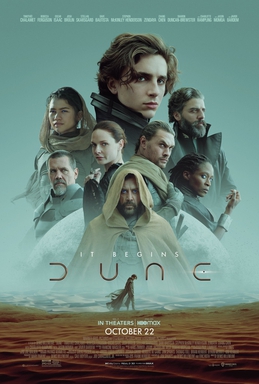
My dad was the one who first introduced me to Dune. We started with the 1984 David Lynch film, famously weird but ultimately endearing to us. I was fascinated by the universe of the movie, even to the point of annoying my dad during church the next morning with endless questions, to the point where I had to be shushed. When I was a little older I dove into the book. It was dense, complex, and a struggle to get through. I was furious when I got to the end to discover that there was a glossary that I could have been using the whole time that my loving father had neglected to tell me about. He thought it was hilarious. I’ve never forgiven him. The book rapidly grew to be one of my very favorites and I read it over and over. Though I never progressed to the rest of the series, as my dad had read them all and didn’t recommend them, Dune was always one of the pop culture bonds we shared.

My dad has dementia. It started with some vision problems soon after he retired. He was eventually diagnosed with Posterior Cortical Atrophy, an Alzheimer’s-like disease that affects the back portion of the brain that controls visual processing. He lost the ability to safely drive, to play golf, to be able to see to navigate around rooms. He’s not blind, strictly speaking, but he may as well be given his limitations. He can’t help out around the house in any way. He “watches” a lot of a TV, but most of the time he doesn’t even look at the screen, he just listens. It’s progressed far beyond his vision by now, affecting every part of his life. His general awareness of the world around him has shrunk, he talks nonsense or makes noises to himself all the time. He’s grown increasingly foul-mouthed, especially in the middle of the night. He has bathroom troubles. He’s occasionally been unable to recognize his wife of over 50 years, though he’s not quite so far gone that he doesn’t remember or recognize anyone or anything. It’s been hard on us all, especially my mother, who is an absolute saint in the way she takes care of him despite the enormous burden this is for her.

When the new version of Dune from Denis Villeneuve was announced 5 years or so ago, I was thrilled. We were due for an update, one that was both more faithful to the book while also being more accessible for a wider audience. At the time, my dad’s dementia hadn’t progressed as far as it has, and I looked forward to discussing the new Dune with him, comparing it to the book and to the 1984 film, seeing where it shined or where it fell short, analyzing the cast, debating the need to split the book into two movies, hoping part 2 would get made, etc. Given his condition, I didn’t expect the same level of conversation as we might have had when I was in high school, it was still something I was excited about.

Of course, by the time the movie was released in October of last year my father’s condition had changed significantly from even just five years before. I still wanted to take him to see it, but I kept coming up with various excuses to not do it. I couldn’t find the right time to go, or somebody was sick, or whatever. I kept making a good faith effort to plan an outing with my dad during its theatrical run, but I never treated it like it was something I really wanted to do. I think deep down I was scared. It wasn’t just the natural fear of having to manage my dad for 3 hours, safely getting him into my car, into the theater, and dealing with anything unexpected that came up, it was also the fear of disappointment. 

I knew that my hopes were destined to not come true. There’d be no exciting anticipation before the movie, no lengthy discussion afterwards. We wouldn’t debate how the movie had handled the many iconic scenes from the book, what had been changed or added or dropped. The best I could hope for would be some awareness or familiarity with certain moments. We’d talked over and over of the Gob Jabbar, so I still held onto hope that it might elicit a reaction from him when we saw it. Or perhaps the first sandworm attack on the spice harvester. Or even Dr. Yeuh and the tooth (which I had pestered him about in church all those many years ago). 

I chickened out, however. I never found an opportunity to watch it with my father. Instead I went to a late night showing with a good friend and fellow Dune fan, and that showing was everything I’d hoped it could be. A great movie with great discussion paired with it, with only a slight pang of guilt that it wasn’t with my dad. I knew he wouldn’t even know to hold it against me, but I still felt like I was letting him down. But hey, I had sort of tried to get it to work out so I could take him, but it just didn’t come together. That happens sometimes, right?

I figured that would be the end of it, but I was wrong. Since Dune was nominated for Best Picture at the Academy Awards, it was given a showing at our local theater among a slate of all the Best Picture nominees. This time, for some unknown reason, my courage didn’t fail me, and I rearranged things to make sure I wouldn’t miss this opportunity again. So on a Saturday afternoon I took my 72 year old father with dementia to see Dune.

I chose seats that wouldn’t require climbing many stairs. I harassed the guy selling tickets to give me paper ticket copies. I helped my dad get his mask on. I bought popcorn for us and I even got him a Coke Icee, which used to be his favorite movie drink. I knew this could very well be the last time I ever get to go to a movie with my dad, the man who helped stoke my love of cinema and who went to a movie with me at least once a week for years and years. I was going to do everything I could to make it special for him, even if he didn’t understand.

Ultimately, that disappointment I had feared turned out to be well founded. On the way there he had asked me, “What’s the name of the movie we’re seeing about?” (His own confused way of asking what we were seeing.) I told him it was Dune and he nodded like he understood. I tried to explain that it was only the first half of the book, but I don’t know whether that meant anything to him. At the theater he couldn’t really drink his Coke Icee because fiddling with his mask and trying to drink out of a straw he can’t see is just too much to ask. He didn’t eat any popcorn. He stared into the distance during the whole movie, with no discernable reaction to anything that happened. I’d hoped for a nod at the famous line, “I hold at your neck the Gom Jabbar,” but nothing. I was struck on my second viewing, watching with my father as my primary consideration, how loud the movie is, particularly once the Harkonnens attack. Dark and loud with explosions and things that would be just indecipherable light to my dad.

There was no discussion afterwards, of course. No talk about gender-swapping Liet Kynes, or the design of the film, or where they decided to split the story. No talk about how we felt about Timothée Chalamet as Paul. Not even any real acknowledgement of the movie at all. Still, I was glad I took him. It did him no harm, it gave my mom a nice quiet afternoon to herself, and it was nice to be able to share that with my dad even if he got nothing from it.

I’m not far from being able to take my son, who is three and a half, to the movies. We’ve had plenty of fun watching all kinds of animated movies at home, both new and classics. He does a good job of sitting still for a movie at home, so he’d probably do just fine in a theater, though we’re going to wait until he’s been vaccinated for Covid before we take him out somewhere like that. Still, I may never get the chance to see a movie with both my dad and my son in the theater. It’s possible within a short while my dad might be in some kind of assisted living situation, and my son may never get to make that kind of multi-generation movie memory like I did with my dad and grandfather.

But despite the disappointment and the sadness, the realizations that the man who raised me isn’t the same as he used to be and that many doors are now closed that I’d hoped would remain open, there’s a positive memory from our movie outing that will always stick with me. It’s one that ultimately has nothing to do with Dune. Before I left to pick up my dad to go to the movie I gave some serious thought to what to listen to in the car. I normally just listen to audiobooks when I drive, but I wanted some music that I thought he’d enjoy.

I ended up picking the 1994 album Cracked Rear View by Hootie and the Blowfish. I could have gone with the Beatles, or CSNY, or Simon and Garfunkel, or any of a dozen other groups that he taught me to love in the same way he taught me to love Dune, but I went with Hootie, which got regular play in my house as a kid. As soon as I pulled the music up in my car, my dad got a huge grin on his face. He sang along to every song in his own creaking way, despite clearly not remembering many of the words or being able to carry a tune. The music jogged something in his memory and every song felt familiar to him. He smiled and sang the whole way there and the whole way back, and from now on whenever I think of Dune I’ll remember my dad, beaten down by the ravages of time, brought back to life by this familiar music. It wasn’t what I’d hoped for from an outing to a movie we both would have looked forward to 10 or more years ago, but it was a moment of connection, a moment of happiness, and a reminder that the dad I love is still inside him and is still human. It’s not everything, but it’s enough.

Review and Analysis – Star Wars: The Rise of Skywalker

riseposter
I haven’t written about movies in over a year and a half, so please bear with me. I just couldn’t let a Star Wars movie pass without making an attempt. This first review section will be spoiler-free, while the second section will be spoiler-filled and have ample warning before you get to it.
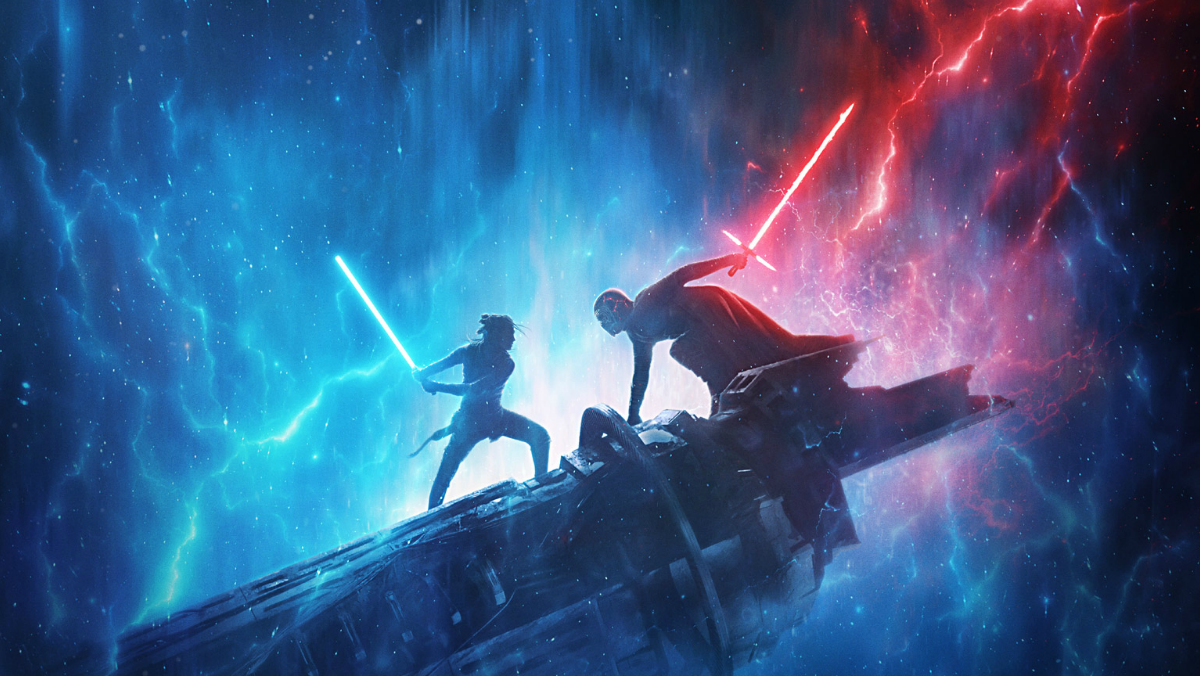
Star Wars: The Rise of Skywalker is a mess. It’s also highly enjoyable. It is satisfying. It is disappointing. It is lazy, pandering, and focus-grouped. It is emotional, heartfelt, and genuine. It honors the legacy and themes of the entire saga. It misunderstands what Star Wars is about. It is silly and dumb. It is a thought-provoking discussion-starter. It is unpredictable. It is so predictable. It wastes characters. It gives characters the opportunity to shine. It answers many questions. It wastes many opportunities. It is the safest Star Wars ever. It is the craziest Star Wars ever.
The best description of The Rise of Skywalker is one I’ve seen making the rounds quite a bit. It is “a lot.” I truly did enjoy it but I can’t honestly say it’s very good. One of the benefits to it simply being “a lot,” jam packed with plot and answers and action and humor and moments to cheer, is that there’s something for almost everyone to like. Conversely, there’s something to bother almost everyone. I feel like The Rise of Skywalker, and perhaps the sequel trilogy as a whole when people look back on it, will end up being a Rorschach test for how people feel about Star Wars and how they approach storytelling generally and the revival of beloved franchises specifically.
On the whole, though, I enjoyed The Rise of Skywalker. It has humor and heart, it serves as a broadly satisfying close on the story of the Skywalkers, and it is generally fun. It has some of the best performances of this sequel trilogy, particularly from Daisy Ridley as Rey and Adam Driver as Kylo Ren, while Anthony Daniels gets to shine as the inexhaustible C-3PO. JJ Abrams and company manage to do a good job crafting a final role for Leia from Carrie Fisher’s deleted scenes from The Force Awakens, and it would have felt wrong for her not to be there. There are moments in the film that made me cheer, made my heart swell, and brought tears to my eyes (an admittedly easy feat).
But I wouldn’t call The Rise of Skywalker a particularly great movie. The script from Abrams and Chris Terrio is riddled with coincidences, plot holes, unexplained important events, and occasionally flat dialogue. Rose has been relegated to a criminally minor supporting role, but even Poe and Finn (who had great arcs in The Last Jedi) are mostly misused. There are new characters like Naomi Ackie’s Jannah and Keri Russell’s Zorii Bliss who are nice additions but aren’t given much of a chance to make an impact in a script that is too stuffed to let things breathe. So much of the movie is devoted to action/plot or to the Rey/Kylo/Palpatine triangle that there’s hardly room for anything else.
The Rise of Skywalker has about 50% too much plot. It’s too obsessed with answering questions that didn’t need answering, and with throwing bones to fans who didn’t like The Last Jedi. It’s never openly antagonistic to Rian Johnson’s vastly superior film, but there’s enough of a course correction there to please fans who felt burned by the previous movie. It feels like it was constructed by committee who sent out surveys to fans on what they’d want to see from the final chapter and wrote the script based on the statistics of the responses. The result isn’t bad, per se, it’s just lazy and pandering, not to mention often extremely predictable.
My ultimate conclusion is that JJ Abrams is a great trailer director. What I mean by that is that he knows how to engage an audience from the start, and he has far less interest in the story as a whole or its conclusion. (And this is coming from someone who deeply loves Super 8.) The sequel trilogy suffers from not having a plan from the start, with Abrams doing his thing (like he did on Lost) getting the ball rolling and letting other people sort things out from there. It really illustrates the limits of “mystery box” storytelling, and I hope Lucasfilm finds a new method going forward. The trilogy was redeemed in my eyes by Rian Johnson’s middle chapter, and from that perspective The Rise of Skywalker is an enjoyable but only serviceable finale.
I’m sure my thoughts and feelings about this Episode 9 will change over time. I wasn’t particularly a fan of The Force Awakens when it first came out, and some things about it still bother me, but it’s grown on me over the last few years, largely due to the strength of the characters it created. I went into The Rise of Skywalker with lower expectations than I usually would for a Star Wars film, and came away generally pleased and entertained. My childhood wasn’t ruined, the sequel trilogy wasn’t ruined for me, and I’m eager for more Star Wars in the weeks, months, and years ahead. It’s still a mess, with some objectively bad mistakes and missteps as well as some things that just didn’t work for me personally, but I’m looking forward to watching it again. The last four years have brought us five Star Wars movies, ranging from spectacular to just fine, and if this is the way this period ends I’m ok with that.
B+
 
***Spoilers Below***
 
So Rey is a Palpatine. It was one of the popular theories, and one that seemed more and more likely to me once it was announced that Palpatine would return for TROS. (Even if I originally assumed she was Luke’s daughter after TFA.) Generally, I’m ok with her being a Palpatine even if it wasn’t what I would have preferred. I liked the idea from TLJ that she really was a nobody, and the idea that you don’t have to come from some famous background to be a hero or be important. On the other hand, there’s something to be said for the more broad idea that you’re not defined by your background, and your name or your parents are not responsible for your legacy. Rey is able to set aside her shameful family name and her evil grandfather and choose a family and a name that has more meaning to her. Star Wars has always been about the families you create being more important than those you’re born with, so in that sense it fits thematically.
Rey’s struggle throughout the trilogy has been about identity. First she defined herself solely by the parents she was waiting for and the longing she had for a family that wanted her. She learned to stop waiting for that family and went looking for “someone to show me my place” in TLJ. But she eventually learned that she alone was enough, and she didn’t need to be defined by a family she had waited for that would never come back. In ROTS she learns she’s a Palpatine and that her parents abandoned her for her own safety, which is kind of a cop out from TLJ’s claim that they sold her for drinking money, but both have enough truth to work with the “certain point of view” theme that is a constant through Star Wars. And I could totally see how choosing the Skywalker name could feel like a step backwards for many people, but I look at it as coming full circle for her, not waiting for someone to bring her meaning, and no longer feeling like she has to stand alone, she chooses to take the name of those who meant so much to her, to keep what they fought for alive in a way that is stronger than blood.
I appreciated the return to Tattooine as a fan, but it doesn’t make a lot of sense as a final resting place for the lightsabers from Rey’s perspective. Leia has no connection to the Lars homestead, but whatever. It’s symbolic more for the story than for the literal actions of the character. What I don’t understand is people claiming online that the scene means Rey is going to now live there? That doesn’t seem implied or stated by the scene at all. I guess it comes from the title of the track on the soundtrack, “A New Home,” but I think believing Rey is actually going to live there seems like a misreading of the character even in a movie as messy as TROS. I kind of hope that she took the kyber crystals from the two sabers and is using them in her new, yellow saber, though.
Then there’s Ben Solo. I haven’t been a fan of Kylo Ren at all. I thought he made for an interesting villain, but I wasn’t eager to see his redemption and I certainly didn’t ship him and Rey. But I very much enjoyed his arc in TROS, and especially Adam Driver’s performance. I appreciate that he was able to be redeemed as Ben Solo without an unrealistically happy ending after participating in the murder of billions with Starkiller Base. I don’t think I would have been able to buy that, though had he survived and gone into hiding to do atone in secret I could have accepted that too. There’s definitely some nice parallels to Anakin with Ben having the power to bring Rey back from death, and his sacrifice was a fitting end to the Skywalker line, a line of Jedi who came into being to balance out Palpatine’s rise and which ended with Palpatine’s fall. I can get on board with that. The scene with his memory of his father was an emotional, but predictable, surprise, and I especially love that his mother was the one to turn him and Rey back from the darkness. Driver really sold the transformation, and his wordless performance as Ben for the rest of the film was truly special.
I’ve admitted to not being a Reylo shipper, and I’m happy to admit that shipping has never been a particularly passionate thing to me in fandoms generally. I enjoy the anticipation of possible relationships, and I definitely have couples I ship, but I’m rarely too upset when things don’t work out. But I also recognize that as a man there is probably something significant I’m missing in Reylo, so I’m trying to do my part to listen to why some people are so upset. I know many women identify with Rey and were thrilled to have a character they could see themselves in in Star Wars. So I can see how it feels like a betrayal that the relationship between Rey and Ben ends in tragedy because it feels like the powers that be are saying to women that they simply can’t have it all. They can be heroes but they have to be alone. I don’t personally read the story that way, but I can definitely see how it would feel like that kind of statement and I have no interest in dismissing that pain or that interpretation. I believe and I hope that Rey goes on to a full and happy life with her friends Finn and Poe and Rose and the droids, finds love and happiness and family and gets to continue being a hero to the galaxy. I don’t think the film contradicts that vision, it just doesn’t take the opportunity to show that a woman can have it all, which is understandably like a betrayal to many.
Speaking of Finn and Poe, what a wasted opportunity for the two of them. There are racial implications to Poe’s backstory as a drug smuggler that I don’t feel qualified to address and which I admit didn’t occur to me until they were pointed out. After all of his growth in TLJ, he basically became Han Solo this time around. Finn had one great scene with Jannah about leaving the First Order, but that was most of his story, too. Apparently his secret for Rey is that he’s Force sensitive? I don’t have an issue with it, but it didn’t add anything to the film and felt kind of tacked on. Really, the biggest missed opportunity was for Finn and Poe to become a couple, which would have worked so well in the film’s finale, but I have no doubt the powers that be weren’t ready to go that bold. LGBTQ+ representation is extremely important, and it’s no small deal that TROS has the first onscreen same sex kiss for Star Wars. But how awesome would have been for Finn and Poe to kiss upon their reunion? That could have been Finn’s secret.
I don’t really know what to say about Palpatine being the puppet master this whole time. It seems like it was the easy decision for the production team to make to please fans and find a way to wrap up the trilogy where they clearly didn’t have a plan. I don’t particularly care that Snoke was grown in a vat, but I don’t have a problem with it either. I can accept Palpatine surviving the end of Return of the Jedi even if it’s inherently silly. It’s just… fine. The Palpatine stuff was the least interesting aspect of the film for me, and this is from someone who loves Palpatine in all of the Lucas films. He’s a fascinating character in the prequels and in ROTJ, but here he was just kind of cartoonish. He’s probably the only villain that would have felt big enough and provide enough of a threat to work with Rey and Ben’s story, so it’s fine from that standpoint, it just wasn’t super interesting to me.
I was kind of overwhelmed by the Jedi voices encouraging Rey, so I’ll have to pay closer attention on the next viewing, but I love that they brought in more than just the obvious ones from the films. Nice to hear Ahsoka and Kanan! As far as other cameos, it was nice to see the Ghost from Rebels and Wedge return in the finale (though right after Wedge lost his adopted son, Snap), and I’ll be curious to watch people dissect the footage as time goes on to see what other hidden gems are scattered among the fleet. I loved the “They’re not a navy, they’re just… people” line so much, and it was one of the most Star Wars lines in the film. The idea that “Rebellions are built on Hope” is one I cling to desperately, and I loved the idea in this film that villains win by making people feel alone.
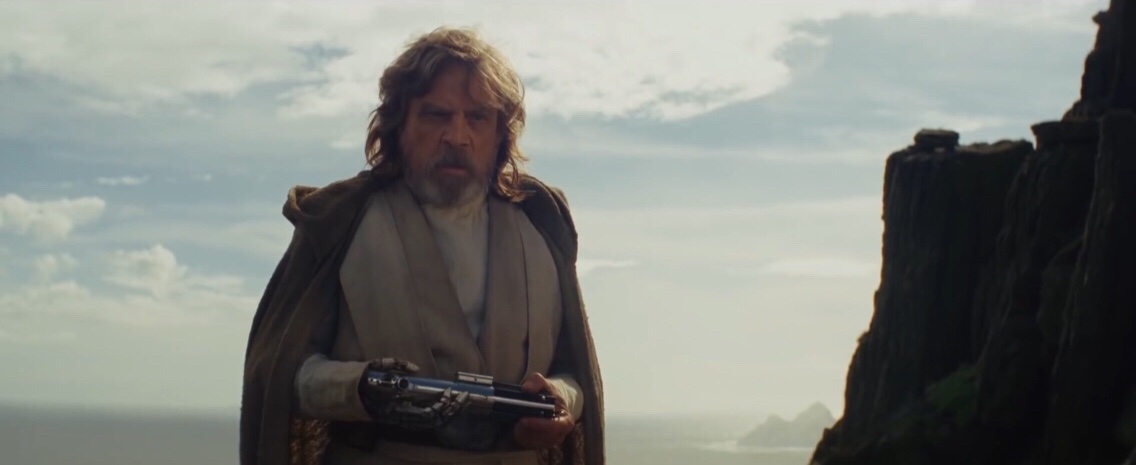
There’s a lot of healthy debate going on about how much TROS was intended to undo TLJ, but a lot of that comes from having lived the fan backlash the last two years. It would be impossible for the experience of watching the movie not to be colored by everything that has happened. But for the most part I read a lot of the “corrections” as growth and development rather than antipathy towards TLJ. Things like Luke preventing Rey from destroying the lightsaber feel like Luke acknowledging his failures, something that feels very in tune with his character growth in TLJ and Yoda’s lesson for him. I choose not to buy into the theory that JJ and Rian hate each other and there’s some kind of war between them. That’s just silly to me, even if they have very different styles of filmmaking and storytelling.
In all, I’m curious to see how and if my feelings about The Rise of Skywalker change with time and repeat viewings. I know I won’t become more accepting of things like the sidelining of Rose or the flattening of Poe and Finn. But things like the overstuffed plot and the Palpatine stuff that I’m neutral on now could go either way. Could I go back in time I would have given this trilogy to a single director, or at least found someone with a singular vision for the sequels. I don’t begrudge anyone being disappointed or hurt, but for now I’m choosing to be positive. It doesn’t undo the things I found most meaningful in The Last Jedi, particularly Luke’s story. It gives Leia a loving ending and Carrie a beautiful sendoff. It leaves the door open for more adventures while putting a reasonably satisfying cap on the Skywalker Saga. And Rogue One still exists. I can be happy with this messy, pandering film for now, and maybe one day I’ll grow to love it.

An open letter of thanks to the artists who helped me over the last year to process my son’s death

To the artists who have helped me so much in the last year following my son’s death,

I’ve written a lot of fan mail over the years, lavishing praise on actors, directors, and musicians and occasionally begging for an autograph. But over the past year I’ve had a more pressing reason to write to a variety of artists. One year ago today, our son Luke died, and my amazing and inspirational wife gave birth to him two days later. I’ve written about Luke a couple of times, both as a form of release or to relate a special experience, but this letter is for something different altogether. It’s to thank the artists who helped me through this journey with their art. Some of this art is new, some of it is older. Some of it helped generally in ways that are probably very common those who have lost a loved one, while some of it helped me specifically when others might have passed it by.

My wife and I received help, love, and support from so many people in our lives, and I hope they all know how much they have meant to us. Our parents, family, and friends have visited, our church and pastors have prayed with and for us, our extended communities both local and online have reached out, and our support group (the MISS Foundation) has been exactly what we needed. No thank you letter could ever express how much debt we owe to and gratitude we have for those many, wonderful people in our lives, even as our journey continues with the birth of Luke’s little brother in three months.

But this is a pop culture blog and this is a thank you of a different sort. This is for those who have carried me along without even knowing it. This is for the love and support you showed me through your art. So thank you. I can only hope that this open letter somehow finds some of you so you can know the impact your works have had. And perhaps other people like me will find their own healing through the arts, and share their own healing, so we can all feel the power that art can have on the soul.

To Lin-Manuel Miranda

I’m sure you hear from people all the time who were inspired in a variety of ways by Hamilton. We gave our son, Luke, the middle name of Alexander, and while I can’t honestly say that he was directly named after either the founding father or the version of Hamilton you wrote and played onstage, I’d be lying if I said that your play was not on my mind when the name occurred to me. I even imagined singing to him “Lucas Alexander Smith. Your name is Lucas Alexander Smith. And there are a million things you haven’t done, but just you wait, just you wait.” Instead, the line that kept popping up in my mind as I watched my wife sleep while we waited for the induction meds to take effect so she could give birth to our stillborn son was “We are going through the unimaginable.” Along with lines from Beauty and the Beast and Buffy the Vampire Slayer, it was a recurring, unintentional phrase that played over and over in my head, and it helped capture the shock we were both dealing with. Our son, Luke, had challenges we knew he would be facing, including heart irregularities, a cleft lip and palate, and a genetic microdeletion, but we were prepared to face those challenges head on with strength and love, and we were ready to give everything to him. And in dealing with those challenges we faced a lot of fears, including the fear that we might lose him. But we still never could have imagined what it would actually be like to be told he was gone. Oddly, despite having listened to Hamilton countless times (though we have yet to see it onstage), my brain didn’t even register the opening lyrics of “It’s Quiet Uptown” until days or weeks later. “There are moments that the words don’t reach, there is suffering too terrible to name, you hold your child as tight as you can and push away the unimaginable.” It’s a line I can no longer hear or think about without vividly remembering holding Luke’s body as tightly as I could, giving him all of the love, hugs, and kisses that I could in the short time we could hold him before he was taken away. I knew firsthand how “It feels easier to just swim down” into my grief.

But “It’s Quiet Uptown” is as much a song of healing as it is of grief. The Hamiltons learn to live with the unimaginable, and we have, too. It’s a constant, ongoing struggle, but like Alexander we pray, we talk to our son, and we’ve learned to appreciate the quiet moments together. My wife and I have found a new strength in ourselves and in each other, and the “grace too powerful to name” has touched us both. And as we’re now expecting our second little boy, due in June, I am once again able to listen to Hamilton with the same joy that it first brought me, but now with a greater appreciation for the story of Alexander and Eliza. Thank you for “It’s Quiet Uptown,” which helped me put words to a grief and a feeling I was unable to articulate on my own, and which helped remind me that healing, connection, and forgiveness are equally part of the story.

To Alan MenkenTim Rice, and Emma Watson

2017’s live-action version of Beauty and the Beast was released a week before our son’s original due date, and the weekend before his scheduled induction. We didn’t know if he would come early and we would be unable to see it, but Luke managed to wait and allowed us to see the film in the theater that Saturday. It was the last movie we got to see with our son. Luke loved music, and would kick whenever the choir at our church would sing or during a song would start during a musical on stage. His love of music is one of the few things we got to know about him before he died, and so the memory of our last movie together being a musical is particularly special. But in the days we spent in the hospital after his death and before his birth, one particular refrain from Beauty and the Beast echoed in my head, much as lines from Hamilton did. In the new song “Days in the Sun,” Belle listens to the enchanted objects in the Beast’s castle sing in hope and longing of the day when they’ll be human again and can feel the sun on their faces, and replies in song, “How in the midst of all this sorrow can so much hope and love endure?” I heard that line over and over again in the sleepless nights in the hospital, but while Belle sang it marveling at the positive outlook of those around her despite their cursed situation, to me it felt more like a question of myself. How could I keep hope and love alive in spite of my overwhelming sorrow? It seemed impossible, but that line evolved for me into a reminder of the importance of hope and love in the midst of sorrow, and it has allowed the film as a whole to hold an even more special place in my heart because it was a moment of love and hope in our lives and our time with Luke. It wasn’t until later that I fully appreciated that the line is actually sung to a different tune, that of “How Does a Moment Last Forever,” a song that’s all about how holding onto the love we have allows stories and moments to live on even after those we love have left us. It’s a struggle for Belle throughout the story, but Maurice’s words as he sings to himself early in the film hold the key, and embody the ways in which I try to keep Luke’s memory alive. “How does a moment last forever? How can a story never die? It is love we must hold onto, never easy, but we try. Sometimes our happiness is captured, somehow a time and place stand still. Love lives on inside our hearts, and always will.” Thank you for giving us a film that provided one final special memory with our son, as well as a song and a story that helped me remember that love can be found in even the most sorrowful of places and the love we hold onto is our way of keeping Luke’s story alive.

To Joss Whedon

I’m sure you get tired of people telling you how much “The Body” meant to them. My wife and I are longtime fans of your various works, and regularly watch and love all of your shows. Given the number of times we’ve watched Buffy, it shouldn’t have been any surprise to me that “The Body” would be on my mind through those long days and nights in the hospital, but I was still struck by how much truth you captured in that heartbreaking and iconic episode. Beyond the fact that I kept hearing Tara’s voice in my head saying “It’s always sudden,” there were so many moments from the episode that in many ways prepared me to deal with death for the first time, if only in such a way that things that might otherwise have caught me off guard instead felt strangely familiar. The bizarre relationship with food, and the way getting something to eat or drink seems like the thing to do to “help” when simultaneously you feel like you’ll never want to eat again. There’s the obsession with things like clothes that don’t really matter, the unexpected outbursts of anger or confusion, and ridiculous things like paperwork, all while the spectre of a dead body hangs over everything. Of course, our son was and is more than a dead body. But while plenty of stories deal with death, loss, and grief, “The Body” deals with the parts of death in America that so rarely are discussed. And while the episode is not a guide, it prepared me for so many of those details and oddities that get lost in the larger picture of the death of a loved one. I had never fully understood the brilliance of the episode before a year ago. Thank you for your beautiful, brutal, and honest look at the ways we respond to death, and thank you for all of your art through the years that has inspired and entertained so many.

To Sir David Attenborough and the crew of BBC’s Planet Earth series

My wife and I are huge fans of the Planet Earth series, and my wife even worked with a BBC crew here in Tucson during filming of the Harris’s Hawks sequence in the “Deserts” episode of Planet Earth 2. She has an animal science degree and a love of animals, having worked in wildlife rehab and at a zoo. Many women pick a show they can watch during middle-of-the-night feedings before their child is born, and my wife planned on bingeing the various BBC nature shows hosted by Sir Attenborough. We already had the various DVDs and Blu-Rays stacked up and ready by the television and ready to go. When we got home from the hospital without our son, we found ourselves with far more time on our hands than we had ever planned for. We had family come to visit, originally planned to see Luke and help us out in the first weeks of caring for him, but the most oppressive moments were those where we sat alone in our quiet house. I was home from work, using the vacation time I had saved up for Luke’s birth, and while we had the time to catch up on all sorts of things we had wanted or needed to do we didn’t have the energy or enthusiasm for them. So without anything else to do, I popped inPlanet Earth, knowing full well that it might be a huge mistake and could reinforce what we were missing. Instead, it brought us an immeasurable amount of comfort. The beautiful images of nature were calming, as was Sir Attenborough’s soothing voice. The many stories of plants and animals across our planet dealing with the harsh realities of life and death helped to give us some perspective, and my wife’s physical recovery and our emotional recoveries went much smoother because of it. The BBC’s nature documentaries are always engaging, educational, and simply gorgeous to look at, but they now have a special place in our hearts for helping us through such a rough time in our lives. I don’t know how we would have gotten through those first weeks without them. And now we have Blue Planet 2 for my wife to watch with Luke’s little brother in a few months!

To Jed WhedonMaurissa TancharoenJeffrey Bell, and Henry Simmons

My wife and I have been fans of Agents of S.H.I.E.L.D. since the beginning. I used to write recaps on this site, but moves to later timeslots and just a general lack of time eventually brought that to an end. Luke died and was born right before the final story arc of season 4, which found our heroes trapped in “the framework,” an alternate reality like the Matrix, where most of the main characters were living different lives due to one change from their past. It was a fun storyline, allowing the actors to play variations of the characters we’d come to love, but the story that really hit us was that of Mack. In the show’s real world, Mack had lost his daughter, Hope, four days after she was born, years before he joined the team. Inside the framework Hope was still alive, and he never knew any reality other than the one in which he’d watch his daughter growing up. He ends up joining the resistance against the forces of HYDRA within the framework, but he never fully accepts that the reality he believes is true is actually a fabrication, and he refuses to return to the real world. Even once he comes to realize the framework is a lie, he still would rather live in a fake world than live in a real world without Hope. It was an emotional storyline, wonderfully written and acted by Henry Simmons, but it wasn’t until my wife pointed out how much she could relate to Mack’s feelings that it really dawned on me what I was watching. Suddenly I realized I knew exactly how he felt, and I would have happily accepted a fantasy world if it meant I could have had Luke back and watched him grow up into a happy kid. I’m sure if someone had offered us a framework we would have hooked ourselves up to it without hesitation. But Mack’s story was cathartic, too, because he eventually was left with no choice but to head back to the real world and face the truth that Hope is gone. But in doing so he rediscovered his feelings for Elena (Yo-Yo), and in doing so he found that he still had the capacity to love and to have hope for the future, even while morning the loss of his Hope. It was both imminently relatable to us and our feelings about Luke, but also was a reminder that there still are things to live for beyond the fantasies we create for ourselves. And now, here we are, expecting our second child in a few months. So thank you to the entire SHIELD team for both an amazing show and for telling the story we needed to hear at just the right time.

To James Gunn

I (intermittently) write about movies. They’re one of my passions. I spent much of my wife’s pregnancy with Luke viewing being a father through the prism of movies. I enjoyed every movie we got to see with him while my she was pregnant, both at home and in the theater. I wondered what the last movie would be that we’d watch before his birth (for a while we did a marathon of movies from the year we were born), and what the first movie would be that we’d watch with him after his birth. I imagined when we might first go to the movie theater as a family, probably to a Disney or Pixar film. And as I said above, we hoped he wouldn’t be born before we could see Beauty and the Beast in the theater. Once Luke died, there was little that was as unappealing as going to the movies. But we’re big fans of the MCU, and the first Guardians of the Galaxy in particular, so it was with an enormous amount of trepidation that we bought our tickets for Vol. 2, our first movie after months of grieving. But your movie ended up being a personal milestone for me, despite the mild panic attack I had as the lights dimmed and the trailers began. It showed me not only that it was ok to laugh again, but that I was actually capable of laughter. It showed me that I could survive a story about fathers and sons, about love and loss. It even had an adorable baby Groot that brought me joy when I feared it would cause me pain. By constantly making the unexpected choice, and by willfully disregarding expectations at every turn, your movie helped to remind me that I’m not beholden to anyone else’s idea of how I should act or who I should be. Guardians of the Galaxy Vol. 2was a huge first step for me along my path of grief and recovery, as silly as that may sound. It showed me that I could love movies again, and for that it will always have a special place in my heart. Thank you for giving my passion back to me.

To Brad BirdDamon Lindelof, and Jeff Jensen

I’ve written a lot about Tomorrowland. (I’ve also annoyed writer Jeff Jensen on Twitter enough that I’m shocked he hasn’t blocked me.) It’s one of my all-time favorite movies, and it’s one of those rare works of art that feels like it was made specifically for me. It’s message of weary yet determined optimism, resonated with me more strongly than almost any work of fiction I’ve ever encountered. But after Luke died, optimism was in short supply, and I wondered if I would ever have that feeling again. It was a long while before I was able to watch Tomorrowland again, despite having a digital copy downloaded on my phone at all times so I can carry it around with me, like I do with my Tomorrowland pin. I feared not only an adverse reaction to it, but also that it would simply have lost the connection that made it special to me. Casey’s crucial, defiant question, “Don’t we, like, make our own destiny and stuff?” might now ring hollow as I’ve experienced firsthand that not everything can be controlled. I needn’t have worried, though. Tomorrowland still touches the special place in my heart that no other movie has, no matter how broken my heart might be. In a large part it’s because Tomorrowland’s brand of optimism is colored by an acknowledgment of the state of the world, to show that optimism is easy when everything is bring and sunny, but it’s much harder when there is seemingly no light to be found. It’s in those moments of darkness that we’re called to be the light we want to see in the world, no matter how much easier it might seem to just give in. I still believe that in every moment there is the possibility of a better future, and I’m still and optimist. So thank you for making Tomorrowland, a movie can still remind me to feed the right wolf.

(As a side note, before Luke was born I pledged to myself that every month after he was born I would give a donation in his honor to a charity or group who are fighting to make the world the sort of place in which we wanted him to grow up. Despite Luke’s death, I carried on with that plan, though now in his memory, and it has helped me to focus on the light in the world, about the thousands of optimists out there feeding the right wolf.)

To Lee Unkrich and Adrian Molina

I was really worried about Coco. I’d been looking forward to the film, as I do with all Pixar releases, for years, but after Luke died I wasn’t sure how well I’d be able to handle a story so focused on death. I fully expected it to be uplifting, as almost all Pixar films are, but the theme and the setting could have been massive triggers for me. Instead, Coco was supremely comforting in ways I had not anticipated. Coco’s version of the afterlife, inspired by the beautiful Mexican culture and beliefs that are always nearby here close to the border in Arizona, was not a sad, frightening specter to haunt my dreams, but was surprisingly full of life. The skeletal forms of Miguel’s departed family are not tormented souls but are instead very much the people they were when they were alive, with the same love and concerns that they carried in life. Coco’s afterlife was vibrant and welcoming to Miguel, even if it was bizarre. But what sticks with me the most today is the importance of memory. We have so very few memories of Luke, and I have even fewer than my wife, who had the privilege and pain of carrying him for nine months. But I remember his love of music (another theme from Coco), and the way he would kick and dance during songs at church or in the theater. I remember the joy of watching him at the ultrasound appointments, even as we came to realize some of the challenges he was facing. And I remember holding his body in my arms and looking at his beautiful face, even as I knew his spirit had moved on to a better place. I remember Luke, and through that memory he lives on, much as Coco’s memory of her father keeps his spirit alive in the afterlife. But there is another side to “Remember Me,” the Oscar-winning song from the film. There’s the hope that Luke’s spirit will remember me despite how little time we had together, and that he will be waiting for me when I reach the other side, much as Miguel’s family waits and watches, taking joy in the lives of those still living. Coco reminds us that death is not the end, and that those who have died are not truly gone but instead they share in our lives as though they were right beside us, listening to us sing. That thought and feeling helps me to keep Luke’s memory in my heart, and I thank you for giving me Coco as a reminder.

To Rian Johnson and Mark Hamill

As much as I worried about Coco, I positively dreaded Star Wars: The Last Jedi, despite my excitement for the next film in the saga. The prospect of hearing my son’s name spoken over and over onscreen, and watching the continuing story of the character (or at least one of) that he was named after, made me a bit of a nervous wreck. I’m already on record as loving The Last Jedi, and I even wrote a separate piece from my review that went into my feelings on how the film used Luke Skywalker so magnificently. But in the months since its release, I’m continually struck by how well The Last Jedi captures my current feelings about our Luke. Both Lukes met an ending that no one expected or even wanted. But those endings were not really the end of their stories, because just as our Luke lives through us and our need to tell his story and remember him, Luke Skywalker lives on through the Force and the impact his deeds had on that galaxy far, far away. The impact of a life is not measured in minutes or in victories, but in the way we allow that life to bring meaning to our own. I was inspired enough by Luke Skywalker to (partially) name my son after him, and I am inspired by our Luke to continue to live my life to the fullest and pass on that inspiration to his little brother. And much like Luke Skywalker learns the futility of cutting himself off from the universe, I have learned that I have more to gain and more to contribute by being a part of the world instead of turning away. It’s easy, in grief or in anger, to run or to hide, and sometimes we have to do that for our own protection. But that can and should never be the end of the story. We owe it to each other, to ourselves, and most importantly to the ones we love to step back out again, to risk the pain, and to find a way to make a difference. Stories have all kinds of different endings, and the world doesn’t always oblige us by giving us the one we imagined. But the power of a story doesn’t lie in its perfectly clean and happy ending, but instead in its ability to grow beyond itself and inspire others. It’s one of the metaphors of The Last Jedi, and it’s a truth I’ve found in the story of our own little Luke. The impact our son has had on our lives is so much more vast than the short time we had with him, and through us our Luke will continue to be a force for good on those around us. In that way, much like Luke Skywalker is now one with the Force and inspiring the galaxy, our son lives on in the lives of those he touched. So thank you, Rian and Mark, for giving me a story featuring one of my favorite characters that was exactly what I needed, which helped me to give voice to my own journey.

With love and appreciation for all of the artists out there who make a difference in the world and in the lives of those experience your works,

Love and Thanks,

Josh Smith

Let’s talk about Luke, and other spoiler-filled thoughts on Star Wars: The Last Jedi

Our son’s name is Luke. I have a ring I wear at all times with his name on it in his memory after he was stillborn nine months ago. And while there were plenty of Luke’s that could have, and did, inspire our son’s name (including the Biblical Luke as well as Lukes Danes and Kuechly), I’d be lying if I said he wasn’t named after Luke Skywalker. It was such an obvious name choice for me that it was set in my mind long before I ever met my wife, and despite never discussing it my best friend still accurately guessed it before we made the name public. My point in all of this is so that when I say that Luke Skywalker is my favorite character from anything I have ever watched, read, seen, or experienced, you understand the depth of what I mean. I’d pick Luke Skywalker over the countless characters who have meant so much to me, from Atticus Finch to Data, more than Hermione, Neville, and Luna, beyond River Tam or Buffy Summers, past even WALL-E or Casey Newton. Luke Skywalker helped me through some of the most difficult times in my life, through depression and isolation. He taught me about storytelling, sparked my love of movies and fanned the flames of my love of reading. So needless to say I had a lot of fear going into Star Wars: The Last Jedi over how my favorite character and my son’s namesake would be treated and used. Ultimately, directory Rian Johnson made a completely different choice than I would have at every possible turn, and the result was a bold, thrilling, adventure that advanced Star Wars in unexpected ways filled with new depths. But I have many, many thoughts to wrestle out with regards to Luke Skywalker that simply couldn’t be discussed in a spoiler-free review. So read on for a more in-depth SPOILER-FILLED look at not only Luke’s story but other aspects of The Last Jedi worthy of discussion.

Seriously, SPOILERS AHEAD!

Continue reading

So, about the ending to Baby Driver…

I really enjoyed Baby Driver. Edgar Wright delivered a tightly crafted, exquisitely choreographed thrill ride of a movie, with a killer soundtrack and some of the best action sequences of the year. I loved the eccentric characters, the chemistry between Ansel Elgort’s Baby and Lily James’ Debora in particular, although at times it felt like it was trying a little too hard to be a Tarantino film, particularly with bits of the dialogue. I’m still amazed by the intricacy of the filming and post production work required to make each moment of the film move in rhythm with whatever song happens to be playing on Baby’s iPod. Baby Driver was a solid A film for me, and I look forward to seeing it again as I know I’ll pick up on many details I missed the first time.

However, I find myself still hung up on Baby Driver’s ending. (Spoilers below, obviously!) Continue reading

Rogue One is not Jyn’s story, it’s the Rebellion’s, and other thoughts

I’ve had all sorts of thoughts rattling around in my head since I first saw Rogue One: A Star Wars Story. I gave it an A in my review, and I stand by that, especially as a reflection of how I feel about the film having now seen it twice. On the other hand, I don’t think Rogue One is necessarily that great of a movie either. It has some major character development issues that are for me its biggest shortcoming, particularly when held up to The Force Awakens whose greatest assets was its characters. So I wanted a chance to talk about the things I love about Rogue One, the things that frustrate me about it, and any other observations I might have. (I did something similar for The Force Awakens.) Needless to say there will be Spoilers Below for anyone who hasn’t seen the film. Here, in no particular order, are some Rogue One thoughts and opinions that continue to clog up my brain. And of course, keep in mind that all of this is coming from someone who unashamedly loves the prequels.

Continue reading

When Movie Audiences Miss the Point

I should have known. When a lady down in the front of my full theater pulled out her cell phone during the pre-show warning to turn off your cell phone in order to scroll through an email full of pictures with her husband, zooming in on each one and discussing it, and continued doing this into Eye in the Sky’s opening credits until I yelled for her to put her phone away, I should have known things were going to go badly. We’ve all had movies ruined by rude audience members, people who won’t put away their cell phones (or don’t know how to put them on silent), never stop talking, eat loud or foul-smelling food, kick your seat, etc. But far more rare is an experience where a movie is ruined because of the audience’s reaction to it, either because they simply did not get the movie’s intentions or because you had a very different emotional response than the people surrounding you in the dark. I endured just such an event while seeing Eye in the Sky, and it not only made it impossible to fully enjoy the film from that moment on but it also destroyed a good bit of my faith in humanity. I was disgusted.

Continue reading