
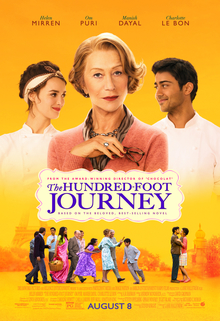
 Sometimes when you go out to a nice restaurant you want the newest, most exciting thing on the menu. You want something that will challenge your taste buds, something surprising and original, which gives you unique ingredients in unforeseen combinations, blowing your mind with its creativity. Other times you want something intimately familiar, a favorite dish you’ve ordered countless times before. It may familiar and routine, but while the mind craves the new sometimes the heart longs for the familiar. The same could be said for film. In The Hundred-Foot Journey, the characters spend their days trying to reconcile the new and creative with the old and familiar. As for the movie itself there’s little new to shock and surprise, but in its familiarity the film feels intimate and reassuring, hitting all of the familiar beats of a dish that we may know very well yet is still wonderfully crafted and a joy to eat.
The Hundred-Foot Journey tells the story of a family from India, who travels to Europe hoping to open a restaurant after a fire back at their home destroyed their restaurant and killed the family’s mother. The Papa of the family drives them around the countryside in search of a place that feels right (and whose produce meets their expectations) until the brakes on their van fail just outside a small, French village. Papa sees this is fate, especially once the vegetables and other items from the local market are discovered to be of the highest quality, and he decides this is where they will open their new restaurant. He finds and purchases a run-down and abandoned building just outside of town which just happens to be across the street from an upscale restaurant (complete with a Michelin Star) and which is run by Madame Mallory, an impossibly snooty and restrained woman.
Things start out poorly. Mallory is offended by the existence of a garish and distinctly Indian restaurant exactly 100 feet across the street, and does her best to put a stop to the family. This launches a war between her and Papa, as they try to outmaneuver each other by buying all of the vegetables or meats that the other restaurant needs or filing noise complaints. Caught in the crossfire of this war are Hassan, Papa’s oldest son and his restaurant’s chef, and Marguerite, a sous chef at Mallory’s restaurant, both of whom are kind-hearted and frustrated by the attitudes of their elders. The story winds its way along familiar paths, as Hassan’s genius as a chef helps both sides overcome their prejudices despite racism rearing its ugly head. Hassan bridges the gap, as he goes to Mallory for training in the French tradition while bringing his Indian expertise to create something new in the hopes of winning Mallory a second Michelin Star.
Director Lassa Hallström serves up a dish with which he should be intimately familiar, as The Hundred-Foot Journey is almost a remake of his spectacular film Chocolat, with chocolate replaced with curry and Helen Mirren instead of Alfred Molina. It’s not an exact copy, as the plots start similarly but diverge as the films go on, but they feel so alike. That’s not a bad thing, as Hallström has a great eye for this sort of film, where uptight, repressed people learn to unwind and be accepting all thanks to some exquisite food. The Hundred-Foot Journey hits the spot in a way that never challenges our expectations but instead fulfills them in a most satisfying way. Even as things take the occasional dark turn, we have a good idea of how the story will play out, although that doesn’t make it less enjoyable when it finally does. It helps that Hallström has crafted a film that’s so outwardly pleasant, from beautiful scenery to the sights and sounds of food that are so rich you can almost swear you can smell and taste them.
The cast does an admirable job hitting all of the right notes. Helen Mirren is ideally cast as Madame Mallory, who is at home throughout her character’s journey from sneering condescension to ally and supporter. She has a great sneer and no one is better at looking down their nose at other characters, but she can also break your heart as her humanity starts to show. Veteran actor Om Puri gets most of the film’s funniest moments as Papa, especially when pitted against Mirren’s Mallory. The two are a great match and their interplay really helps sell the movie. But the film’s heart belongs to Manish Dayal as Hassan. Dayal gives Hassan the soulful aspect of a man trying to find his place while being pulled in a million different directions. It’s easy to believe him as a chef, but even more as someone trying to find a balance between tradition and innovation and occasionally getting lost in the struggle. He has an easy chemistry with Charlotte Le Bon as Marguerite, who is charming and warm, and the pair makes for a believable Romeo and Juliet sort of romance. I only wish that Marguerite served a larger role in the story than simply serving Hassan as a character. When the pair are equals everything works well, but the moments where she is brushed aside so that Hassan can take the spotlight were common enough to be frustrating.
The Hundred-Foot Journey is one of those films that come and go and barely register a blip on the larger film world, despite having names like Steven Spielberg and Oprah Winfrey among its producers. Much like a well-known dish, the film is pleasant and enjoyable and hits the spot, but isn’t the sort to stick in your memory for very long. In several years this film will have faded into the background, with memories of it mingled with many other films of the same type, of a hundred other meals that made you smile but never left a lasting impression. Not every culinary creation has to change the world, nor does every film, and sometimes all we want is that nice, warm, satisfied feeling in our bellies. That’s what The Hundred-Foot Journey is. It’s not a movie that will one day grace my DVD collection, nor one I feel the need to rush out and see again while it’s in theaters. But as a way to spend two hours in a darkened theater, it hit the spot. I may have known exactly what I was going to get when I ordered it from the menu, but that familiarity doesn’t dull the taste or make it any less welcome, and sometimes the familiar can be just what you need.
A-
 The Love Pirate
Pingback: Review: The Hundred-Foot Journey | Tinseltown Times